Why do so many financial services organizations still struggle with “dirty data,” and how can it be fixed?
Dirty data often starts at intake. By addressing data collection and workflow issues at the front end – where information first enters your systems – you can dramatically reduce compliance risk, save time, and ensure every decision is based on accurate, complete data.
That’s the key message shared in, “Fix the Front End: How Financial Services Can Eliminate Data Chaos at the Source,” featuring David Scovetta, Director of Security and Compliance at FormAssembly, and Rory Galvin, Founder and CEO of Navirum, a digital transformation consultancy for the financial services industry.
You can watch the webinar on-demand here, or read on for a detailed overview of what you need to know.
Key Takeaways
- Dirty data is costly. Inaccurate or incomplete data impacts compliance, client experience, and operational efficiency.
- Start at the source. Clean, standardized data intake prevents downstream chaos.
- Automation beats manual work. Replacing spreadsheets and email-based collection processes with integrated workflows saves time and reduces errors.
- Security = integrity. Built-in compliance controls protect and preserve data quality.
- No-code tools drive agility. Empowering business users to build secure, compliant forms accelerates transformation.
The Hidden Cost of “Dirty Data”
Data is the fuel that powers financial operations, but if that data is inaccurate, incomplete, or inconsistent, every downstream process suffers. Nearly every digital transformation project in the financial services industry begins with the same obstacle: poor data quality.
Dirty data can take many forms:
- Incomplete information from manual entry or migration
- Duplicated or outdated records from legacy systems
- Corrupted or misformatted data due to integration errors
- Localized or inconsistent fields (for example, names or addresses stored in different formats)
These issues don’t just slow down workflows – they directly affect compliance, accuracy, and client trust.
“Organizations are responsible for the data they process. If something’s missing, incorrect, or altered – even slightly – it can impact compliance programs like KYC, AML, and GLBA safeguards.” – David Scovetta, Director of Security and Compliance, FormAssembly
Fixing the Front-End Chaos
The best way to stop bad data from spreading is to prevent it from entering your system in the first place. The most effective strategy is to fix problems at the intake layer – the point where data first enters your systems.
Here’s how to start cleaning up your intake process:
- Map your intake points. Identify every source of incoming data (including web forms, spreadsheets, and legacy systems) and track where that data goes next.
- Automate manual processes. Replace time-consuming, error-prone workflows with digital forms and integrated automation.
- Limit free text. Use drop-downs, standardized fields, and validation rules to minimize inconsistencies.
- Centralize data intake. Fewer entry points mean less duplication and more reliable data overall.
Integrations and Security: The Foundation of Clean Data
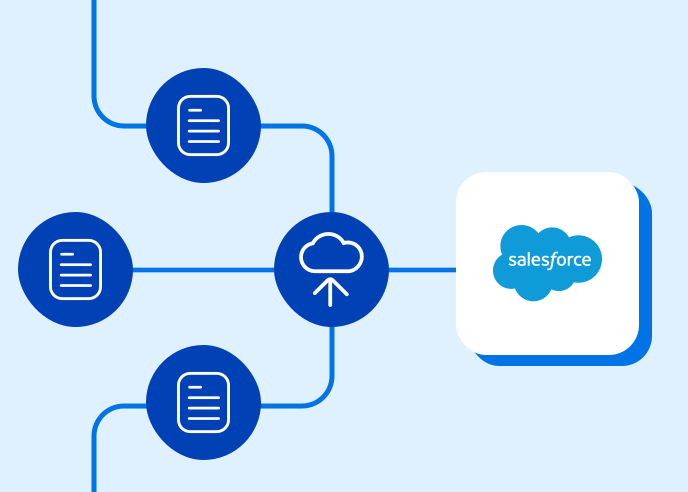
When data moves between systems like Salesforce, security and compliance are just as critical as accuracy.
FormAssembly Atlas offers advanced security and compliance features, such as encryption in transit and at rest, single sign-on, and audit logging, helping organizations meet standards under ISO 27001, SOC 2, and more.
Real-World Success: One Wealth’s Transformation
One Wealth, a San Francisco–based wealth management firm, partnered with Navirum to simplify client onboarding. Facing multiple data sources, legacy processes, and migration challenges, the company needed a secure, compliant way to collect and sync client information into Salesforce.
By implementing FormAssembly forms and integrations, One Wealth:
- Simplified complex onboarding workflows
- Reduced manual data entry and reconciliation
- Improved both advisor and client experience
- Strengthened compliance and data accuracy
“The ease of use, security, and flexibility of FormAssembly were key. It stood out from other tools because it combined efficiency with compliance.” – Rory Galvin, CEO, Navirum
The Compliance Risks of Outdated Tools
Continuing to rely on spreadsheets, email attachments, or outdated systems can create significant compliance risks. Incomplete or inaccurate data can lead to serious regulatory consequences, especially when that data is used to make client or financial determinations.
Beyond compliance violations, outdated tools also make auditability and data lineage nearly impossible to maintain. When information is collected through disconnected spreadsheets, PDFs, or emails, it becomes difficult to prove where that data originated, who handled it, or whether it’s been altered. This lack of visibility can complicate audits, delay reporting, and expose your organization to further scrutiny.
By contrast, centralized, automated data collection tools maintain a clear chain of custody – helping you demonstrate compliance, reduce manual rework, and build long-term data trust.
The Automation Advantage
For financial organizations that need both agility and compliance, FormAssembly can help bridge the gap between IT and business teams.With secure, prebuilt connectors for Salesforce and robust field mapping tools, you can create compliant, efficient data collection processes within minutes.
Fix Your Front End with FormAssembly
Financial services organizations can’t afford to make decisions on bad data or waste time cleaning it up after the fact. By addressing the intake layer with modern, compliant tools like FormAssembly, you can streamline data collection, eliminate data chaos, and build confidence in every process that follows.
Learn more about how FormAssembly supports financial services firms.
Interested in exploring Atlas? Book a personalized demo or start a free trial today.