To build a GLBA compliant customer data intake workflow, financial institutions need more than a secure form. They need a structured, governed approach to how customer data is collected, protected, and delivered into core systems.
Under the Gramm-Leach-Bliley Act (GLBA), the responsibility to safeguard nonpublic personal information (NPI) begins at the point of collection. For most organizations, that means digital intake forms. If data is inconsistent, unsecured, or improperly routed at this stage, it introduces risk across compliance, operations, and customer trust.
This guide outlines how to design intake workflows that align with the GLBA Safeguards Rule financial services forms requirements while supporting scalable, high-quality data collection.
Understanding GLBA Requirements for Data Collection
GLBA establishes three core obligations:
- Financial Privacy Rule: Requires clear notice of data-sharing practices and opt-out mechanisms
- Safeguards Rule: Mandates a comprehensive information security program
- Pretexting Provisions: Prohibit unauthorized or deceptive data collection
For intake workflows, the Safeguards Rule is the most operationally significant. The updated Safeguards Rule requires financial institutions to implement:
- Encryption of customer data in transit and at rest
- Multi-factor authentication for system access
- Continuous monitoring of systems handling NPI
- A documented, written information security program
Any workflow involving customer NPI data collection compliance falls within this scope. That includes digital forms capturing names combined with financial details, Social Security numbers, income data, or credit-related information.
Deciding What Data to Collect
Effective compliance starts with data minimization. Collecting unnecessary NPI increases risk without adding value. A well-designed intake workflow ensures that every field serves a defined business and regulatory purpose.
For most onboarding scenarios, data falls into three categories:
Identity verification (KYC)
Legal name, date of birth, address, and government-issued ID numbers
Account setup data
Information required to establish financial products or services
Communication and consent data
Customer preferences and acknowledgment of disclosures
Every field included in the workflow should map to a specific use case. If it does not support onboarding, servicing, compliance, or reporting, it should be removed. This approach reduces exposure and strengthens customer NPI data collection compliance from the outset.
Take the first step towards compliant data collection.
Schedule your personalized demo today.
Securing Data Transmission and Storage
The Safeguards Rule requires financial institutions to protect NPI throughout its lifecycle.
For digital intake workflows, this includes:
- Encryption in transit: TLS 1.2 or higher for all submissions
- Encryption at rest: Industry-standard encryption (e.g., AES-256) with defined key management
- Field-level encryption: Additional protection for highly sensitive data such as Social Security or account numbers
Field-level encryption ensures that sensitive values are encrypted before leaving the user’s browser, reducing exposure even within intermediary systems.
FormAssembly supports these requirements with:
- Encryption in transit and at rest
- Field-level encryption for sensitive inputs
- Secure handling of data prior to delivery into downstream systems
This enables organizations to align intake workflows with GLBA Safeguards Rule financial services forms requirements while maintaining a secure, scalable architecture.
Mapping Data to Salesforce Financial Services Cloud
A compliant intake workflow must also produce usable data.
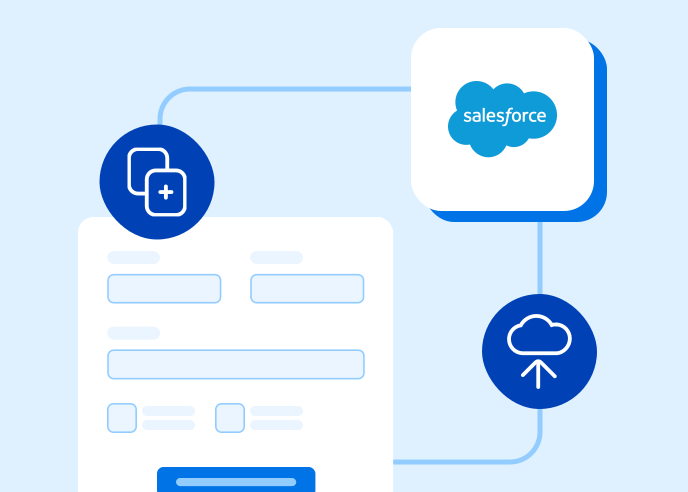
For organizations using Salesforce Financial Services Cloud (FSC), proper data mapping ensures that information is structured, complete, and immediately actionable.
Typical objects involved in FSC compliant intake forms include:
- Contact: Customer identity and demographic data
- Financial Account: Product-specific details
- Account and Household: Relationship structures
- Custom objects: Institution-specific data models
Each form field should be mapped to a defined object and field in FSC before the form is deployed. This prevents downstream issues such as incomplete records, inconsistent formatting, or manual rework.
Duplicate management is also critical. Intake workflows should:
- Check for existing records before creating new ones
- Match based on key identifiers (e.g., name, date of birth, contact details)
- Update existing records when appropriate
This ensures a single, accurate customer profile and reduces operational risk.
Documenting the Workflow for Examiner Review
To fully build a GLBA compliant customer data intake workflow, documentation is as important as implementation, as regulators may review both the security program and the actual data flow.
Intake workflows must be clearly documented and aligned with stated controls. Key documentation should include:
- Data elements collected and their business purpose
- Encryption standards at each stage of the data lifecycle
- Access controls and permission structures
- Audit logging of data access and modifications
- Third-party vendor security posture (e.g., DPAs, certifications, audit reports)
This documentation should be maintained as a living resource. Any changes to forms, fields, or routing logic should trigger an update to ensure ongoing compliance.
Building a Secure, Scalable Intake Foundation
A well-designed intake workflow does more than meet regulatory requirements. It creates a secure, consistent foundation for customer data across systems.
By aligning intake processes with GLBA Safeguards Rule financial services forms standards and integrating directly with platforms like FSC, financial institutions can:
- Reduce manual processing and data errors
- Strengthen security and compliance posture
- Improve data quality and usability
- Deliver a more efficient, trusted customer experience
The key is treating data collection as a governed process, not just a front-end interaction. When intake workflows are structured, secure, and connected, they support both compliance and long-term operational scale.
Need help using FormAssembly?
Our Knowledge Base has step-by-step guides to walk you through the platform.