Anti-money laundering compliance requires financial institutions to collect, verify, and monitor customer information at a level of detail and consistency that manual processes struggle to sustain. The regulatory expectations under the Bank Secrecy Act and FinCEN’s Customer Due Diligence rule have grown steadily, and the documentation requirements for AML programs are extensive. At the same time, the customer experience implications of a slow, friction-heavy onboarding process are real and commercially costly.
Digital form workflows connected to Salesforce Financial Services Cloud offer a path that reduces both the compliance risk and the customer friction. Here is how the pieces fit together.
The Regulatory Foundation: CDD and Beneficial Ownership
FinCEN’s Customer Due Diligence rule requires covered financial institutions to identify and verify the identity of customers, identify and verify beneficial owners of legal entity customers, understand the nature and purpose of customer relationships, and conduct ongoing monitoring to identify and report suspicious transactions.
The beneficial ownership requirement, which applies to legal entity customers, requires collecting the names, addresses, dates of birth, Social Security numbers or passport numbers, and ownership percentages for all individuals who own 25% or more of the entity, plus one individual who controls the entity (regardless of ownership percentage). This information must be collected at account opening and updated when the institution becomes aware of changes.
Standard CDD requires collecting similar identity information for individual customers, plus documentation of the purpose of the account and expected transaction activity. Enhanced due diligence (EDD) applies to higher-risk customers and relationships and requires deeper documentation of the customer’s business, source of funds, and anticipated transaction patterns.
Structuring the AML Intake Workflow
An effective AML data collection workflow has distinct stages that correspond to different risk levels and customer types, rather than a single universal intake form applied to all customers regardless of entity type or risk profile.
Individual customer onboarding requires identity verification data, account purpose documentation, and the standard disclosures and certifications. Legal entity onboarding requires the same, plus beneficial ownership certification for all qualifying owners and the controlling individual. Higher-risk customers, whether flagged by the institution’s risk scoring model or by specific customer characteristics like PEP status or high-risk jurisdiction, enter the EDD pathway with additional documentation requirements.
Conditional logic in the intake form handles this branching automatically. A customer identifying as a legal entity triggers the beneficial ownership section. A customer whose profile matches the institution’s EDD criteria receives additional questions and documentation requests. The form adapts to what the customer’s situation actually requires rather than presenting everyone with the maximum set of possible questions.
Connecting AML Data to Salesforce Financial Services Cloud
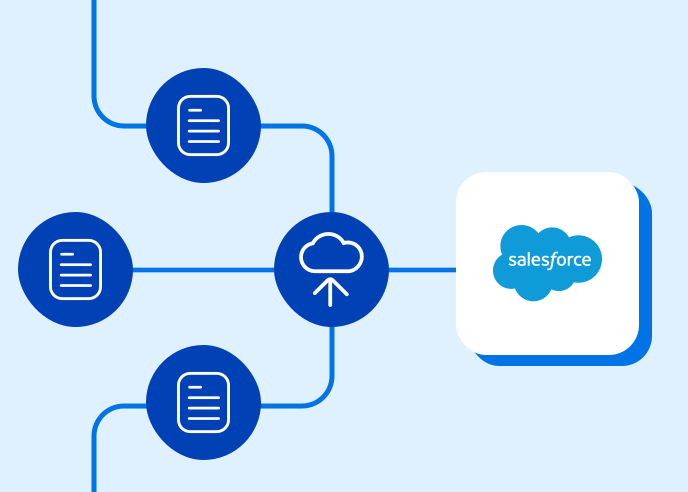
AML data collected through FormAssembly forms routes to Salesforce Financial Services Cloud objects that support the institution’s ongoing monitoring and compliance documentation needs.
Individual customer identity data creates or updates Contact records with the relevant KYC fields. Beneficial ownership information for legal entity customers creates related Contact records for each beneficial owner, linked to the Account record for the entity through FSC’s relationship model. Account purpose documentation and risk classification information populates fields on the Financial Account object.
The Salesforce record created by the intake form becomes the foundation for the institution’s ongoing CDD documentation. When circumstances change, such as a beneficial owner transfer, a change in account purpose, or a transaction pattern that triggers enhanced review, the FSC record provides the baseline against which changes are measured and documented.
Learn how to digitize your client forms with FormAssembly.
Schedule your personalized demo today.
Certification and Document Collection
AML regulations require institutions to collect customer certifications, not just information. The beneficial ownership certification is a legal document in which the customer certifies the accuracy of the beneficial ownership information provided. The certification must include specific language prescribed by FinCEN and must be signed by the customer.
FormAssembly’s e-signature capability allows the beneficial ownership certification, account purpose certification, and any other required compliance certifications to be embedded directly in the intake form and executed with a legally valid electronic signature under the ESIGN Act. The signed certification creates a timestamped record that attaches to the Salesforce Account record, providing the documentation the institution needs to demonstrate compliance during examinations.
Document upload fields for identity verification documents, corporate formation documents, and any EDD-required materials route uploaded files to the Salesforce record for review by the compliance team. Digital document collection through the intake form is faster than mail-in document requests and produces a cleaner documentation trail than documents received via email attachments.
Ongoing Monitoring Data Collection
CDD is not a one-time event. Financial institutions are required to update customer information when they become aware of changes and to conduct periodic re-reviews of higher-risk relationships. Building the workflow for ongoing monitoring data collection at the same time as the initial onboarding workflow avoids the common situation where institutions have strong onboarding processes but no structured mechanism for collecting updated information from existing customers.
A periodic review form pre-filled with existing FSC data asks customers to confirm or update their information, certify continued accuracy of beneficial ownership information, and acknowledge any relevant disclosures on a documented schedule. The review submission updates the FSC record with the new information and a timestamp, creating the documentation trail that demonstrates the institution’s ongoing monitoring program is functioning as required.
For high-risk relationships requiring more frequent review, FormAssembly’s workflow automation features can trigger review forms on a schedule defined by the customer’s risk classification in Salesforce, ensuring that EDD customers receive more frequent review touchpoints automatically rather than requiring manual tracking by the compliance team.
Need help using FormAssembly?
Our Knowledge Base has step-by-step guides to walk you through the platform.