Updated May 7, 2026
Quick answer:
Wealth management client onboarding is the process of bringing new clients into a wealth management firm, from initial inquiry through identity verification (KYC and AML), document collection, signature, and account funding. Modern firms increasingly digitize this process to compress timelines from weeks to days, reduce errors, and meet regulatory requirements.
According to PCBB’s 2023 Digital Onboarding Report, 90% of financial institutions report that some potential customers give up part-way through the onboarding process and never finish opening an account. Reducing that drop-off is what good digital onboarding is for.
Clients who can afford wealth management services expect a seamless, high-touch experience that prioritizes convenience, speed, and privacy.
Traditional onboarding processes are not exactly frictionless. They often involve printing, filling out forms, signing, scanning, and emailing, steps that are time-consuming and prone to errors.
Imagine asking the CEO of a Fortune 500 company to trust your firm with their wealth, but before you can even get started, they need to pause their packed schedule, add an initial to page 4 they missed, and then re-scan and email the entire document back to you. You are not exactly broadcasting the firm as a beacon of modern wealth management.
Below, we cover why digital onboarding has become essential, the key benefits it brings to both clients and firms, and how to implement it without disrupting compliance.
Why digital client onboarding is essential
In wealth management, onboarding is a critical touchpoint, and it is where digital solutions shine. Features like prefillable forms, conditional logic, and e-signatures let firms offer a faster, more secure, and more personalized experience.
Wealthy clients expect onboarding to match the firm’s capacity to manage their complex needs. Per PCBB, 90% of financial institutions report that some potential customers give up part-way through onboarding and never start an account. The most common reasons cited are complexity, lack of access to identity documents, processes that take too long, and forms that ask for too much information up front.
Wealth management is also highly regulated. KYC (Know Your Customer) and AML (Anti-Money Laundering) requirements demand rigorous checks, and manual processes are vulnerable to errors. By automating onboarding, financial services firms can streamline client verification, ensure compliance, and maintain secure, audit-ready records, all while minimizing the risk of human error.
Shifting to digital eliminates outdated manual processes, reduces reliance on middlemen, and improves data accuracy, building both trust and efficiency with clients.
4 benefits of automating the onboarding experience
- Cost reduction. Automating manual tasks frees up resources for higher-value work.
- Enhanced efficiency. Less paperwork, faster turnaround, and fewer handoffs between teams.
- Improved client experience. Personalized, error-free, mobile-friendly flows clients can complete on their own time.
- Data security and compliance. Built-in encryption, access controls, and audit trails align with the regulations the firm already has to meet.
How to take client onboarding digital
Choose the right tools
Start by selecting software that integrates with your CRM (most wealth management firms standardize on Salesforce) and offers advanced form-building features that automate and structure data collection. FormAssembly creates secure, branded forms that automatically sync with client data, eliminating the need for manual updates.
When evaluating a platform, make sure it aligns with your firm’s regulatory compliance needs, especially around data security and privacy.
Customize for client needs
Digital tools can be tailored for different client types. Onboarding a high-net-worth individual may require additional documentation or specific services that differ from a standard client. Tailoring the forms and workflows to each client tier ensures a personalized experience while still meeting all compliance requirements.
Step-by-step implementation plan
To roll digital onboarding out cleanly, follow these six steps:
- Assessment. Evaluate the current onboarding process and identify pain points or bottlenecks.
- Tool selection. Choose the digital onboarding solution that fits your needs (look for scalability, integration options, and security features).
- Integration. Work with your tech team to integrate the platform with your existing CRM and other systems.
- Employee training. Make sure the team understands how to use the new platform end to end.
- A/B testing. Compare the new digital workflow against the legacy process. Measure time to onboard, error rates, and post-onboarding satisfaction.
- Launch and monitor. Roll out to incoming clients. Make sure your platform provides analytics to track submission rates and includes e-signature and payment integrations so the entire flow can complete in one place.
Key challenges in digital onboarding (and how to overcome them)
Integration with existing systems
The first hurdle is making sure the new solution works smoothly with the systems already in place. Pick a platform with strong integration capabilities (native CRM connectors plus webhook and REST API support) so the transition does not stall on technical issues.
Security concerns
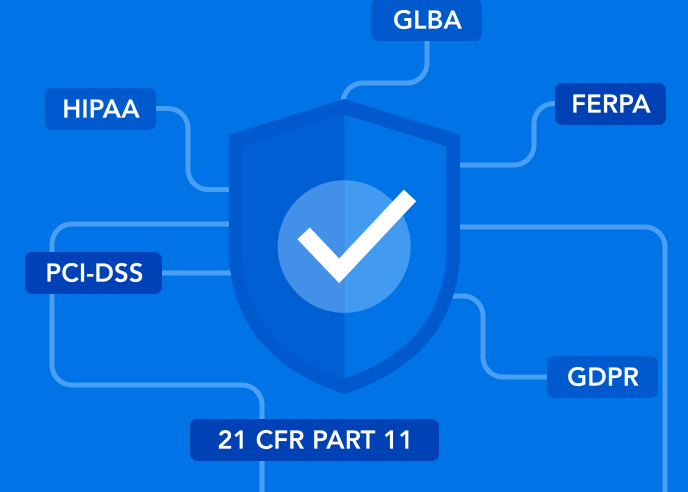
Protecting client data is non-negotiable. Look for an onboarding platform with encryption in transit and at rest, multi-factor authentication, and compliance with the standards that apply to your firm: HIPAA, PCI DSS, GDPR, and GLBA. As financial services firms are increasingly the target of sophisticated breaches, the data layer should be the strongest link in the workflow, not the weakest.
Compliance risks
Digital onboarding can actually simplify compliance when done right. Look for a platform that automates key compliance checks and maintains detailed audit logs, and verify that the vendor regularly updates the platform to stay aligned with evolving KYC and AML requirements.
How to know if your digital onboarding is working
Track these four KPIs to measure the impact of the new process:
- Compliance scores. Audit logs and the percentage of submissions that pass KYC and AML on the first try.
- Time to onboard a client. Average days from initial inquiry to a funded account.
- Client satisfaction. Post-onboarding survey scores and qualitative feedback.
- Error reduction. Submissions with missing or invalid data, before and after digitization.
What to do next
If you want a deeper, prescriptive playbook for the compliant intake layer underneath wealth management onboarding, the natural next read is How to Build a GLBA-Compliant Customer Data Intake Workflow from Scratch. It walks through the specific controls required at the data layer.
Frequently asked questions
What is wealth management client onboarding?
Wealth management client onboarding is the process of bringing a new client into a wealth management relationship, from initial inquiry through identity verification (KYC and AML), beneficial ownership confirmation, document collection, signature, and account funding. The goal is to set up the client and the firm to work together with full regulatory compliance and a complete client profile.
How long does wealth management onboarding typically take?
Manual paper-based processes routinely take two to four weeks. Modern digital onboarding compresses that to days, sometimes hours, because identity verification, document collection, signature, and account creation can happen in parallel and most checks can run automatically.
What is the difference between KYC and AML?
KYC (Know Your Customer) is the front-end identity verification: confirming the client is who they say they are, understanding their financial profile, and assessing risk. AML (Anti-Money Laundering) is the broader regulatory regime that KYC sits inside, requiring ongoing transaction monitoring and reporting on suspicious activity over the lifetime of the relationship.
What information is required during wealth management onboarding?
At minimum: legal name, date of birth, government-issued ID, Social Security or tax ID, address, source of funds, employment information, and beneficial ownership details for entities. High-net-worth onboarding often adds investment policy statements, signed advisory agreements, accredited investor certification, and trust or LLC documentation as required.
Modernize your onboarding process
If you are asking clients to trust you with their wealth, the firm needs to demonstrate it is on the cutting edge, not stuck in the past. By embracing digital tools, wealth managers reduce administrative overhead while delivering the seamless experience clients expect. Schedule a demo of FormAssembly to see how it fits.