Public records requests are a legal obligation and an operational burden that most government agencies manage ineffectively. A constituent submits a request by email or through a paper form. The request lands in a shared inbox or a filing cabinet. Someone manually routes it to the relevant department. That department responds, sometimes, and the response may or may not find its way back to the requester in a documented, auditable way.
The Freedom of Information Act at the federal level and equivalent open records laws at the state and local level impose response time requirements, fee schedules, and exemption documentation obligations that are difficult to satisfy consistently without a structured intake and tracking workflow. Digital forms connected to a Salesforce case management system provide the infrastructure to make public records management both compliant and operationally sustainable.
What a Digital Records Request Intake Form Needs to Capture
The intake form is the starting point for a records request workflow, and the data it captures determines how efficiently the request can be processed. At minimum, the form should collect the requester’s contact information, a clear description of the records being requested (including date ranges, subject matter, and any known record types), the requester’s preferred delivery format, and acknowledgment of the agency’s fee schedule and processing timeline.
For agencies subject to fee waiver provisions, the intake form should include a fee waiver request section with the relevant eligibility criteria. Capturing fee waiver requests at intake rather than handling them as a separate follow-up interaction reduces processing time and creates a documented record of the waiver request and the agency’s response.
Requester identity verification requirements vary by jurisdiction and record type. Some records requests require proof of identity; others do not. The form’s identity verification section should reflect the agency’s specific legal requirements for the record types it manages, not a blanket policy applied uniformly to all requests.
Routing Requests to Salesforce Case Management
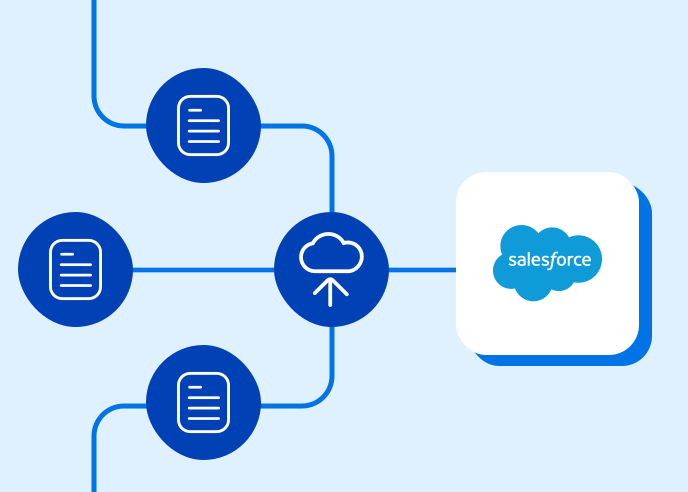
When a records request form is submitted, the submission should immediately create a Case record in Salesforce with the request details, the requester’s Contact record (created or matched from existing data), and a status that triggers the appropriate review workflow.
Salesforce Case management provides the infrastructure to track requests through each stage of the response process: receipt, assignment to the responsible department or records officer, review and processing, response preparation, and delivery. Stage changes can trigger automated notifications to the requester, keeping them informed of progress without requiring manual status communications from the agency.For agencies subject to statutory response time requirements, such as the FOIA 20-business-day response deadline for federal agencies, Salesforce Case records can include a calculated due date field that drives dashboard alerts for cases approaching their deadline. Compliance officers can see at a glance which cases are at risk of missing statutory deadlines without manually tracking each request.
Explore FormAssembly for Government Agencies
Learn more about how FormAssembly supports public sector teams
Managing Exemptions and Partial Disclosures
Most records requests require the reviewing officer to make legal determinations about whether specific records or portions of records are exempt from disclosure. Exemptions under federal FOIA and state open records laws cover categories including personal privacy, law enforcement investigations, deliberative process, attorney-client privilege, and national security.
Documenting exemption determinations on the Salesforce Case record, with the specific exemption claimed and the legal basis, creates an auditable record that supports agency defense of withholding decisions if a requester challenges the response. A structured exemption documentation form that routes to the Case record is more reliable than ad hoc email documentation that may be incomplete or difficult to locate during an appeal.
For partial disclosures where some responsive records are provided and others are withheld, the Case record should document which records were provided, which were withheld, and the specific exemption applied to each withheld record. This level of documentation is required for a defensible response under most open records frameworks.
Requester Communication and Status Tracking
One of the most common complaints about government records request processes is the lack of visibility into request status. Requesters submit requests and hear nothing until the agency is ready to respond, which may be weeks or months later. Digital workflows connected to Salesforce can address this directly.
Automated confirmation emails sent immediately upon form submission tell the requester that their request was received, assign a tracking number, and communicate the expected response timeline. Salesforce workflow automation can trigger subsequent notifications when the request is assigned to a processing officer, when additional information is needed from the requester, and when the response is ready.
For agencies willing to provide a self-service status portal, FormAssembly forms with Salesforce pre-fill can provide a case status lookup where requesters enter their tracking number and see the current status of their request. This reduces inbound status inquiry calls and emails significantly, since requesters can check status themselves rather than contacting the records office.
Document Fulfillment and Delivery
The final step in a records request workflow is delivering the responsive records to the requester. Digital delivery is faster and cheaper than physical mail and creates a documented delivery record that paper fulfillment does not.
Salesforce’s document management capabilities, combined with a delivery notification form sent to the requester, provide a structured fulfillment workflow. Responsive records are attached to the Case record, the requester receives a notification with a secure download link, and the delivery is logged with a timestamp. If the requester has questions about the response or wants to appeal a withholding decision, the complete documentation trail is in Salesforce and accessible for review.
Need help using FormAssembly?
Our Knowledge Base has step-by-step guides to walk you through the platform.