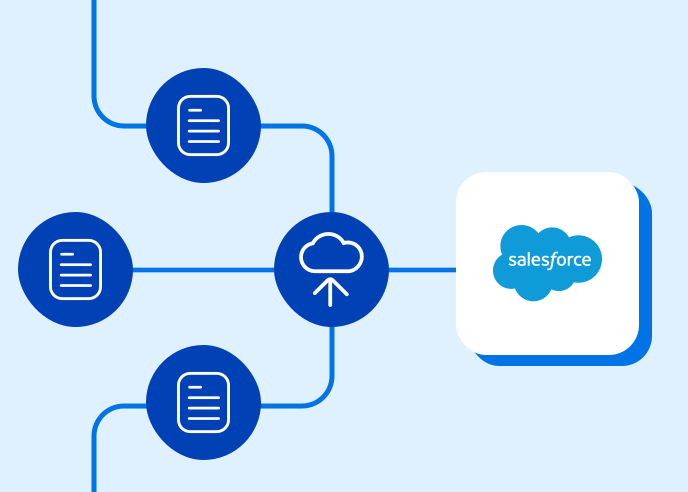
Salesforce Health Cloud has become a meaningful part of how a growing number of healthcare organizations manage patient relationships, care coordination, and operational workflows outside the EHR. Hospitals, health systems, payers, and life sciences companies are running Health Cloud alongside their core clinical systems to handle the relationship and operational layers that EHRs were never really designed for.
But the gap between what Health Cloud delivers as a platform and what healthcare organizations actually need to operate complete patient-facing workflows is wider than the product positioning suggests. Understanding that gap matters for IT and operations leaders making implementation decisions and planning the broader stack around it.
What Health Cloud Actually Provides
Salesforce Health Cloud is a healthcare-tailored extension of the core Salesforce platform. It includes a managed data model designed around patients, providers, and care coordination, a set of pre-built objects and relationships that reflect how healthcare organizations track patient journeys, and integration paths to clinical systems like Epic and Cerner.
The data model is the most substantive piece. Health Cloud provides objects for Patients, Care Programs, Care Plans, Care Gaps, Health Conditions, and the relationship structures that connect these to the standard Salesforce Contact and Account objects. Where a generic Salesforce org would force the organization to build all of this with custom objects, Health Cloud provides the structure out of the box with associated reports, page layouts, and process automation.
Layered on top, products like Patient Service Management add case management for patient services workflows, and integration capabilities like the EHR connector support data exchange with clinical systems through HL7 FHIR APIs. The combination produces a relatively complete relationship management environment for healthcare organizations that need to coordinate patient interactions across multiple touch points.
Where Healthcare Organizations See the Biggest Operational Gains
The organizations getting the most out of Health Cloud tend to follow a similar pattern. They consolidate patient relationship data that previously lived in disconnected systems, including the EHR for clinical records, the patient portal for digital interactions, separate tools for care coordination, and ad hoc spreadsheets for outreach campaigns. All of this comes together into a single Salesforce environment where staff can see the complete relationship history for any given patient.
That consolidation produces several specific operational improvements. Care coordinators can see a patient’s care plan, prior outreach activity, and any flags from previous interactions in one place rather than checking multiple systems. Patient services teams can manage intake workflows alongside ongoing engagement activities in the same environment. Population health teams can identify patients who fit specific care management criteria with documented care histories rather than relying on EHR query gymnastics.
The reporting layer is where the consolidation pays off most visibly. Healthcare organizations running Health Cloud well can produce cross-functional reports, including patient acquisition by source, care plan adherence by population, and outreach effectiveness by campaign, without the manual data integration that characterizes most older healthcare technology stacks.
The Integration Gap
Where Health Cloud falls short is at the patient-facing intake layer. Health Cloud is a CRM. It manages relationships, tracks interactions, and routes work. What it does not provide is the form-based intake layer that captures most of the data feeding into those relationships in the first place.
Healthcare organizations discover this gap quickly. The pre-visit patient intake form, the consent acknowledgment form, the patient satisfaction survey, the referral submission form, the care program enrollment form, and the post-discharge follow-up survey are all data collection workflows that need to write to Health Cloud but are not themselves part of Health Cloud. Most organizations handle this with a patchwork of tools, including web forms built in the patient portal, third-party form builders for one-off needs, paper forms scanned into document management systems, and email-based collection for departments that have not adopted any structured intake.
Each of these gaps is a data quality problem. A form that does not write directly to Health Cloud requires staff to manually transfer submissions, which introduces errors and delays. A form that writes inconsistently to Health Cloud creates record fragmentation, duplicate patient records, and incomplete relationship histories. A form built on a platform that has not been vetted for HIPAA compliance creates real exposure under the Privacy Rule and Security Rule.
What This Means for Healthcare Organizations Evaluating Their Stack
For healthcare organizations currently running Health Cloud or evaluating it, the question is not whether Health Cloud is the right relationship management platform. The platform’s positioning in healthcare is strong enough that this is mostly a settled question for organizations with significant patient relationship management needs. The harder question is what fills the form and intake layer that Health Cloud does not address.
The answer most organizations converge on is a dedicated form platform that connects natively to Health Cloud’s data model. The criteria that matter for this decision are specific. Direct integration with Health Cloud objects, not just generic Salesforce Contacts and Accounts, is the foundation. A form built for patient intake should write to the Patient object with the correct record type and field mapping, not to a custom field on a Contact record. A form built for care program enrollment should create the appropriate Care Program Enrollee record linked to the relevant Health Cloud objects, not a generic record that requires manual reconciliation.
HIPAA compliance posture matters at a deeper level than most non-healthcare platforms address. Any platform handling patient data needs a signed Business Associate Agreement, encryption of PHI in transit and at rest, role-based access controls, and audit logging that supports the Security Rule’s audit controls requirement. Platforms designed primarily for marketing or general business use typically do not address these requirements as a first-class concern.
The platform should also support the kinds of form capabilities healthcare workflows actually need. Conditional logic that adapts forms based on earlier patient responses. Prefill that populates returning patient information from Health Cloud records. E-signatures for consent acknowledgments and authorizations. Document upload for insurance cards, identification documents, and medical records.
Where FormAssembly Fits
FormAssembly is built specifically to fill the form and intake layer that Health Cloud does not include. The Salesforce connector writes directly to Health Cloud objects including Patients, Care Programs, Care Plans, and Care Plan Activities, with support for the custom objects healthcare organizations add to their Health Cloud configurations.
For healthcare organizations running Health Cloud, this means pre-visit intake forms, consent acknowledgments, care program enrollments, satisfaction surveys, and the dozens of other patient-facing intake workflows can all write to the same Health Cloud environment that powers the rest of the organization’s operations. The data quality problems that come with parallel form systems disappear. The HIPAA compliance posture is centralized rather than fragmented across multiple vendors. And the integration overhead that comes with building custom connections from each form to Salesforce gets handled by a platform that already understands the Health Cloud data model.
Health Cloud answers the CRM question for healthcare. The form layer is the question most organizations are still working through. The organizations getting the most out of their Health Cloud investment are the ones that have answered both.
Explore FormAssembly for healthcare
Secure patient data from the first touch.