Most government agencies don’t have a data problem. They have an infrastructure problem.
The data is there. Permit applications, grant submissions, benefit enrollments, inspection reports, constituent surveys, public health intake forms. Every program is producing it. The issue is that the systems collecting that data were built at different times, by different teams, with different tools, and almost none of them were designed to work together.
The result is a fragmented infrastructure that creates real operational costs: staff re-entering data by hand, IT teams managing a sprawl of form tools with inconsistent security controls, and program directors working around systems rather than through them.
Building a modern government data collection infrastructure doesn’t mean replacing everything at once. It means understanding what a connected, compliant, and scalable foundation looks like, and making deliberate decisions to move toward it. Here’s what that looks like in practice.
The Problem with How Most Agencies Collect Data Today
For many agencies, data collection infrastructure evolved rather than being designed. A department needed a form, someone found a tool that worked, and it stuck. Then another department did the same thing with a different tool. Over time, the agency is running five or six different form platforms, none of which connect to each other or to the core CRM.
From an IT operations perspective, that sprawl is expensive in ways that aren’t always visible until something goes wrong. Every tool is a separate vendor relationship, a separate security review, a separate access control policy, and a separate source of potential compliance exposure. When a public records request comes in or an audit gets triggered, tracing data across that kind of environment is painful.
From a program perspective, the cost shows up differently. Staff spend time on manual data transfer that should be automated. Form updates require IT involvement that slows down delivery. Reporting takes longer because the data lives in multiple systems that don’t talk to each other.
None of this is unique to government, but government agencies face it with higher stakes. The compliance requirements are more stringent, the constituent trust implications are more significant, and the budget constraints make redundancy harder to sustain.
The Core Components of a Modern Data Collection Infrastructure
When IT and operations directors at government agencies talk about modernizing data collection, the conversations tend to land on the same core requirements. Not because they’re following a template, but because the operational pressures push toward the same solutions.
A single, governed platform for form creation and management.
The goal isn’t to have the most sophisticated form tool. It’s to have one platform that all departments can use, with central visibility into what forms exist, who has access to them, and how they’re configured. That kind of governance is hard to achieve when every department is running its own solution.
Direct, reliable integration with Salesforce.
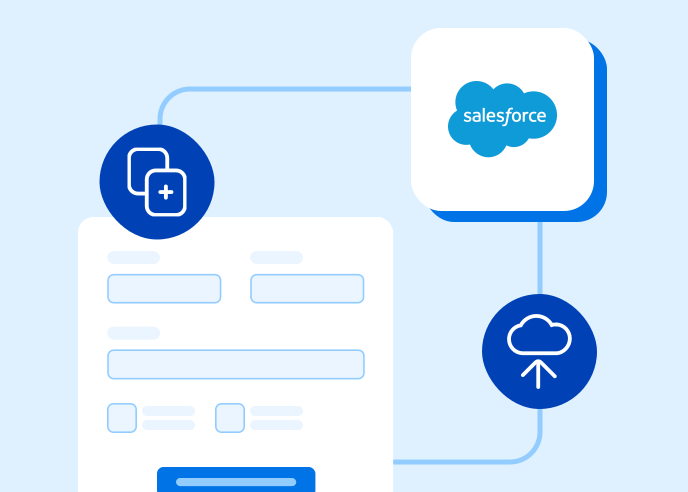
Most mid-to-large government agencies that have invested in CRM are running Salesforce Government Cloud. The data collection layer needs to connect to it natively, not through workarounds or scheduled exports. When a form is submitted, the record should exist in Salesforce immediately, correctly mapped, without staff intervention. FormAssembly’s Salesforce connector is built specifically for this, allowing agencies to create or update any Salesforce object at the moment of submission.
FedRAMP authorization.
Any cloud-based tool handling federal or state government data needs to meet FedRAMP standards. That’s not optional, and for IT directors it simplifies a significant part of the vendor evaluation process. A FedRAMP-authorized platform has already passed independent security assessment against NIST 800-53 controls, which means the security review conversation is a confirmation rather than a discovery process.
Accessibility compliance built into the output.
Government digital services are required to meet Section 508 of the Rehabilitation Act and WCAG 2.1 accessibility standards. An infrastructure that requires manual accessibility audits for every form is an infrastructure that creates constant risk. The platform itself should produce accessible output by default.
Validation and workflow logic that keeps data clean.
The quality of the data that enters downstream systems depends on how well the collection layer is designed. Field-level validation, conditional branching, pre-fill from existing records, and required field logic should all be available without custom development. Clean data at the point of collection is far less costly than cleaning it later.
Elastic scalability for demand spikes.
Government agencies deal with predictable demand surges, open enrollment windows, grant deadlines, emergency response intake, public comment periods. Infrastructure that requires manual intervention to scale, or that degrades under load, is a liability at exactly the moments when reliability matters most.

How This Comes Together in Practice
Consider what a consolidated data collection infrastructure actually changes for a government IT team.
Instead of managing vendor relationships and security reviews for multiple form platforms, the team maintains one. Instead of building custom integrations for each department’s tool, there’s a single Salesforce connector that handles all submission routing. Instead of chasing down accessibility issues on a form-by-form basis, the platform handles it. Instead of responding to outages during peak demand, the infrastructure scales automatically.
For program directors, the change is equally concrete. Launching a new intake form doesn’t require a project ticket and a two-week development queue. Updating an existing form for a policy change happens in hours, not weeks. Reporting is faster because the data is already in Salesforce, already clean, already structured the way downstream systems expect it.
This isn’t a hypothetical vision of what government technology could be. It’s what agencies that have invested in a modern data collection infrastructure are already experiencing.
Making the Case for Infrastructure Investment
For IT and operations directors working within constrained budgets, the business case for consolidating data collection infrastructure usually starts with cost and risk.
On cost: maintaining multiple form platforms means paying for multiple licenses, supporting multiple integrations, and dedicating staff time to multiple systems. Consolidation typically reduces both direct spend and operational overhead. The question isn’t whether a modern platform has a cost, it’s whether that cost is lower than the total cost of the current fragmented state.
On risk: fragmented infrastructure creates compliance exposure that’s hard to quantify until it materializes. Inconsistent access controls, no central audit trail, tools that haven’t been formally assessed against federal security requirements. These aren’t hypothetical risks for government agencies. They’re audit findings waiting to happen. A FedRAMP-authorized platform with centralized governance reduces that surface area significantly.
On efficiency: the staff time spent on manual data entry, form maintenance, and integration troubleshooting across a sprawl of tools is a real cost that rarely shows up on a line item but accumulates constantly. Modernizing the infrastructure recovers that time and redirects it toward work that actually advances program goals.
Where FormAssembly Fits
FormAssembly is a FedRAMP-authorized data collection platform built for organizations with serious compliance requirements and deep Salesforce dependencies. For government agencies, that combination is directly relevant.
Agencies use FormAssembly to consolidate form creation across departments, connect directly to Salesforce Government Cloud, ensure accessible output on every public-facing form, and maintain the kind of central governance that makes audits straightforward rather than stressful.
If your agency is working toward a more connected, compliant data collection infrastructure, FormAssembly is worth a closer look.
Explore FormAssembly for Government Agencies
Learn more about how FormAssembly supports government IT and operations teams on our Government Industry page.