Clinical trial data collection operates under a regulatory framework that most enterprise software was not built to satisfy. The FDA’s 21 CFR Part 11 sets the requirements for electronic records and electronic signatures in FDA-regulated industries. ICH E6 Good Clinical Practice guidelines define the data integrity, traceability, and audit trail standards that apply to clinical research while HIPAA governs the handling of participant health information throughout the trial lifecycle.
Digital forms play a role in several stages of the clinical trial process: participant screening and enrollment, informed consent documentation, adverse event and safety reporting, and ongoing participant data collection. Getting the implementation right in each of these stages requires understanding both the regulatory requirements and the operational realities of clinical research.
21 CFR Part 11: What It Requires for Electronic Data Collection
Part 11 applies when electronic records are used to satisfy FDA record-keeping requirements and electronic signatures are used as substitutes for handwritten signatures. For clinical trials, this covers informed consent documentation, case report forms, adverse event reports, and any other records that would otherwise be maintained in paper format.
The key requirements under Part 11 are system validation (the system must be validated to demonstrate it consistently produces accurate and reliable records), audit trails (the system must generate computer-generated, time-stamped audit trails that record changes to electronic records), access controls (system access must be limited to authorized individuals), and electronic signature requirements (electronic signatures must be linked to their respective electronic records and include the signer’s name, date and time, and the meaning of the signature).
For form platforms used in clinical trial data collection, this means the platform must provide documented validation protocols, tamper-evident audit logging, role-based access controls with individual user accounts, and an electronic signature implementation that meets Part 11’s specific technical requirements. Off-the-shelf form tools without these capabilities cannot be used for Part 11-regulated data without significant additional controls.
Participant Screening and Eligibility Forms
Clinical trial enrollment begins with screening potential participants against inclusion and exclusion criteria. Screening forms collect demographic information, medical history, current medications, and answers to eligibility-determining questions. The outcome of the screening determines whether the individual qualifies for the trial and what additional procedures are required before enrollment.
Conditional logic is particularly valuable in screening forms. A participant who answers ‘yes’ to an exclusion criterion can be routed to an early exit message without being presented with the remainder of the screening questions. A participant who meets all inclusion criteria can be routed directly to the next stage of the enrollment process. This reduces unnecessary burden on ineligible participants and staff time spent reviewing forms from participants who were never qualified to enroll.
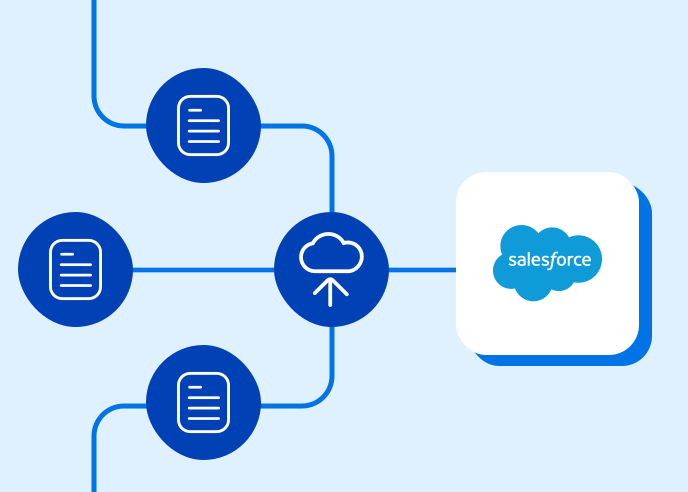
Screening data routes to the participant’s Salesforce record as a pre-enrollment Contact or Lead, with the screening outcome documented as a field value or related record. Eligible participants proceed to the enrollment workflow; ineligible participants can be tracked for future trials or referred to other programs as appropriate to the protocol.

Informed Consent Documentation
Informed consent is one of the most regulated data collection events in clinical research. ICH E6 Good Clinical Practice requires that the consent process be documented in a way that confirms the participant received and understood the information disclosed, had the opportunity to ask questions, and voluntarily agreed to participate. Under Part 11, electronic informed consent must meet the same standards as paper consent with a handwritten signature.
An electronic consent form built for clinical trials presents the full informed consent document, provides a mechanism for the participant to ask questions (typically through a link to contact the study coordinator or a scheduled call), requires an active signature action that constitutes the participant’s consent, and captures the date, time, and identity of the signing participant.
The consent form generates a signed PDF or equivalent record that is stored in the study’s trial master file and attached to the participant’s Salesforce record. Re-consent processes, required when the protocol is amended or when a participant’s circumstances change, use the same form structure with updated consent language, and the new consent record supplements rather than replaces the original to maintain the complete consent history.
Adverse Event and Safety Reporting
Adverse event reporting is a time-sensitive process with defined regulatory timelines. Serious adverse events must be reported to the FDA within specific windows (7 days for unexpected fatal or life-threatening events, 15 days for other serious unexpected events). Internal reporting to the sponsor and investigational review board runs on parallel timelines.
A digital adverse event reporting form that routes immediately to the relevant Salesforce Case record and triggers automated notifications to the sponsor, safety team, and site coordinator eliminates the coordination delays that characterize paper-based SAE reporting. The timestamp on the form submission creates a documented receipt record that supports the regulatory reporting timeline.
FormAssembly’s conditional logic can route adverse event reports based on severity classification, ensuring that serious adverse events trigger immediate escalation workflows while non-serious events follow standard documentation procedures. This triage at the form level reduces the risk of a serious event being treated as routine due to routing error.
Ongoing Participant Data Collection
Longitudinal trials require data collection at defined intervals across months or years. Patient-reported outcomes, follow-up assessments, protocol-required questionnaires, and visit documentation forms need to reach participants at the right intervals, be completed and returned before the visit window closes, and route to the correct study record with the correct timepoint designation.
Automated form delivery triggered by Salesforce date fields tied to each participant’s enrollment date and visit schedule ensures that the right form reaches each participant at the right time without manual coordination by the study coordinator. Completion status tracking in Salesforce flags overdue assessments for coordinator follow-up before the visit window closes. Data from completed forms routes to the participant’s study record with the timepoint and visit metadata needed for downstream data analysis.
Explore FormAssembly for Healthcare
See how FormAssembly keeps your data collection processes HIPAA-compliant.