Data governance programs at large organizations tend to start with the data already sitting in systems of record: master data management, access controls in the warehouse, lineage tracking. The point where that data first enters the organization, the form a prospect, patient, applicant, or member fills out, is often left out of the governance conversation entirely, even though it is where quality problems and compliance exposure both originate.
Why Intake Is a Governance Blind Spot
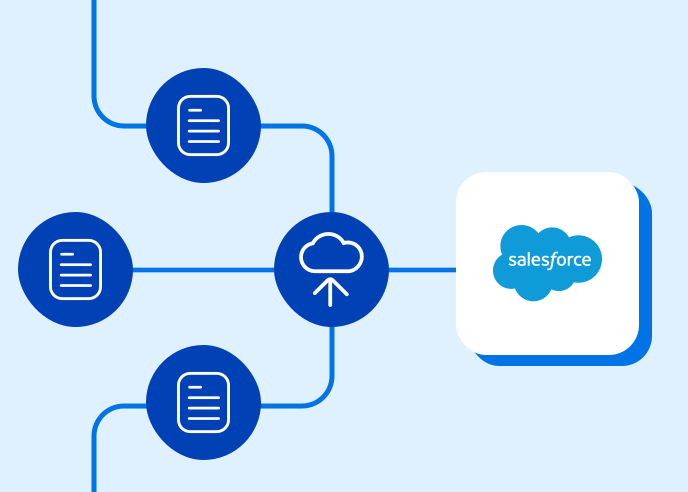
A CIO or CISO can enforce field-level security and sharing rules inside Salesforce with confidence. The same organization frequently has a dozen unmanaged form tools feeding that Salesforce instance, each with its own access controls, its own data retention behavior, and no consistent audit trail connecting a submitted record back to the form version and consent language a person actually saw. Tool sprawl at the intake layer undermines governance work happening everywhere else in the stack.
This shows up most clearly during an audit or a security review, when a team can explain exactly how data moves once it is in Salesforce but struggles to answer basic questions about the ten different forms feeding it: who can access submissions before they sync, how long raw submission data persists, and whether the consent language matches what compliance signed off on eighteen months ago.
What Governed Intake Actually Requires
Treating the form layer as part of the governance program means a small, specific set of controls: role-based access controls, encryption in transit and at rest, and independent security certifications applied to the intake layer itself, not just to the systems downstream of it. Field-level permissions on the form itself, so a submission respects the same sharing rules Salesforce enforces downstream. An audit trail on the form and its changes, not just on the resulting Salesforce record, so a compliance team can show what version of a form and its consent language collected a specific submission. Centralized administration, so one team can see every active form across every department rather than discovering new ones during an incident.
The Consolidation Case
Consolidating intake onto a governed platform is also where the cost argument and the compliance argument line up. Fewer standalone tools means fewer vendor contracts, fewer security reviews to run, and fewer places sensitive data can leak out of the systems IT actually monitors. Executive sponsors evaluating this shift tend to frame it as risk reduction first and cost reduction second, since the license savings from retiring five point-tools rarely outweigh the exposure one ungoverned tool represents.
Where FormAssembly Fits
FormAssembly’s approvals, field-level permissions, and Salesforce architecture extend the governance controls an organization already enforces in Salesforce back to the point where data first enters the system. That closes the gap between a well-governed CRM and an ungoverned collection of form tools feeding it, without adding a separate governance platform to manage on top.
See for yourself
Book a personalized demo or request a free trial of the FormAssembly platform.