The case for digitizing government data collection is not hard to make in the abstract. Paper is slow, error-prone, difficult to audit, and inaccessible to constituents who cannot physically visit an office or navigate a postal system. Most government leaders already know this.
What is harder to see clearly is what the transition actually looks like in practice, which processes are moving first, what technology is enabling them, and what the operational reality is for agencies that have made meaningful progress. Here are five patterns that define how government agencies are replacing paper forms with secure digital workflows today.
1. Permit and License Applications Are Moving Online First
Permit and license applications are among the highest-volume, most process-intensive form workflows in state and local government. They require structured data collection, document attachments, fee payments, status tracking, and interdepartmental routing. They are also the forms constituents interact with most frequently and where friction in the process has the most visible impact on public perception of government service quality.
Agencies moving these workflows online are replacing paper application packets with structured digital forms that validate data at submission, collect required attachments digitally, route to the appropriate review queue automatically, and provide applicants with status visibility without requiring a phone call to the permitting office. The processing time reduction is substantial, and the data quality improvement is immediate since digital forms eliminate the transcription step between receipt and entry into the permitting system.
2. Benefit and Service Applications Are Being Redesigned Around the Constituent
Traditional government benefit applications were designed around agency data needs, not constituent experience. The result was long, complex forms that assumed familiarity with government terminology and required constituents to provide information the agency could have retrieved from its own systems.
Agencies redesigning these workflows are taking a different approach. Pre-fill from existing constituent records in Salesforce Government Cloud reduces redundant data entry for returning applicants. Conditional logic removes sections irrelevant to the applicant’s specific situation. Plain language rewrites replace bureaucratic instructions that drove abandonment. The result is shorter forms with higher completion rates and cleaner data.
3. FedRAMP-Authorized Platforms Are Replacing Informal Workarounds
One of the less visible aspects of government digital transformation is the cleanup of informal data collection practices that accumulated over years of departments solving their own problems without central IT involvement. Shared Google Forms, public SurveyMonkey links, emailed PDF attachments, and department-managed spreadsheets are all common in government environments that lack a governed digital collection platform.Agencies consolidating around a FedRAMP-authorized platform are eliminating these shadow IT practices and replacing them with a governed system that IT can audit, manage, and include in FISMA compliance documentation. The security improvement is real, but so is the operational improvement. Central form management means IT knows what is being collected, by whom, and with what security controls in place.
4. Emergency and High-Volume Intake Processes Are Being Built for Scale
Emergency response agencies, public health departments, and disaster relief programs have learned through experience that paper-based intake fails at scale. When an emergency benefit program opens or a public health event requires mass data collection, the intake infrastructure needs to handle volume spikes without degrading performance or requiring manual triage of paper submissions.
Cloud-native digital collection platforms scale elastically to handle demand spikes that would overwhelm paper-based processes. During an emergency housing assistance program rollout or a mass vaccination campaign requiring appointment registration, the intake form needs to remain available and functional regardless of how many people are trying to access it simultaneously. Building that infrastructure before it is needed is the lesson most agencies have drawn from the programs that failed under load.
5. Document-Heavy Workflows Are Being Consolidated into Single Digital Interactions
Many government service workflows that appear to be single transactions are actually multi-step processes involving several separate form submissions, document attachments, and back-and-forth communications between the agency and the constituent. When each of those steps is handled on paper or through email, the workflow is slow, error-prone, and opaque to both parties.
Digital workflows can consolidate these multi-step processes into a single constituent-facing interaction with branching logic that surfaces each step at the right moment. A conditional routing approach allows agencies to collect all required information upfront and automatically identify which cases need additional documentation or review, rather than discovering gaps in the review process and going back to the constituent for more information days later.
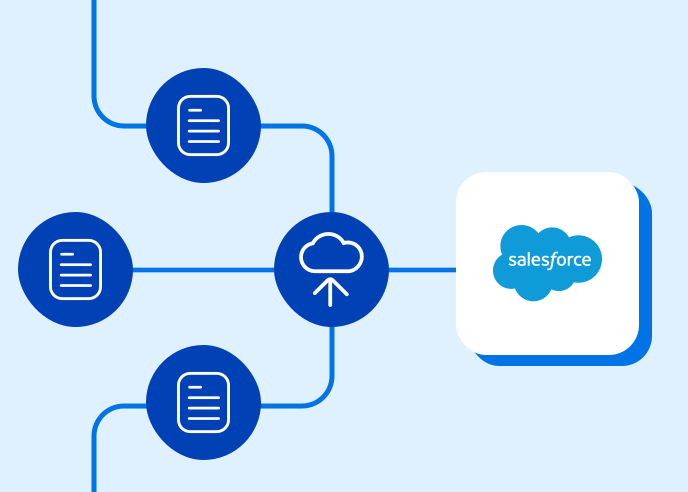
FormAssembly’s multi-page form capability and Salesforce integration support these consolidated workflows. A constituent completes a single form interaction that routes to the correct Salesforce Case with all required documentation attached, eliminating the coordination overhead that characterizes paper-based equivalent processes.
Explore FormAssembly for Government Agencies
Learn more about how FormAssembly supports public sector teams