Financial services buyers evaluating form platforms are usually solving three overlapping problems at once: collecting payment information safely, verifying customer identity, and getting clean data into Salesforce without manual re-entry. The PCI Security Standards Council, which launched PCI DSS in 2006, defines the baseline requirements for any system that stores, processes, or transmits cardholder data, and that standard shapes what a financial services form vendor has to support before payment collection is even a safe option.
What PCI DSS Actually Requires From a Form Vendor
A form platform collecting payment information needs to either be PCI DSS compliant itself or route cardholder data through a certified payment processor without the form platform ever storing or directly handling the raw card data, which reduces the platform’s own compliance scope.
Buyers should directly ask which model a vendor uses, since a platform that touches raw cardholder data carries a materially higher compliance burden than one that tokenizes or redirects to a certified processor.
FormAssembly
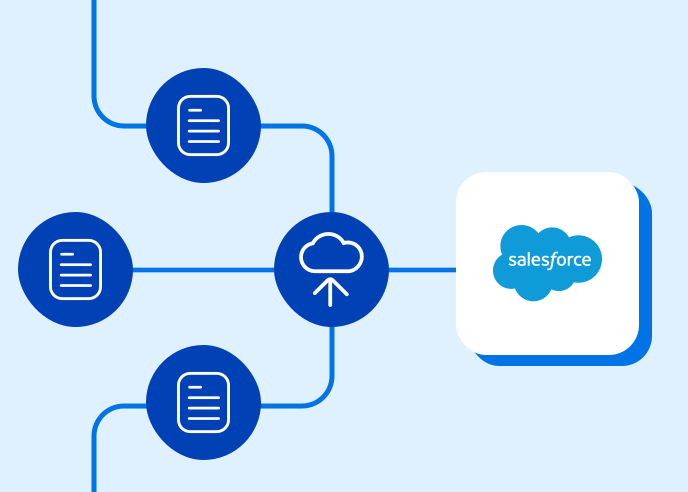
FormAssembly supports PCI DSS-aligned payment collection, conditional logic that adapts KYC intake by entity type and ownership structure, and document upload tied directly to identity and ownership verification fields. Forms connect directly to Salesforce, writing account and application data into the firm’s system of record without a middleware layer, and every submission and approval decision is captured in a complete audit trail.
FormAssembly is the strongest fit among this group for financial services firms evaluating payment security, KYC workflow, and Salesforce connectivity together, rather than assembling that combination from separate tools.
Jotform
Jotform supports PCI-compliant payment collection through its integrated payment gateway partners and offers a wide range of payment processor integrations, including Stripe. Its broad template library and general-purpose flexibility make it accessible for financial services teams running straightforward payment or application forms, though its Salesforce connectivity is one of many general CRM integrations rather than a purpose-built financial-services workflow.
Formstack
Formstack supports PCI DSS-compliant payment collection alongside document generation and e-signatures, and its enterprise tier includes SOC 2 Type II certification, which financial services compliance teams typically require in a vendor security review. Formstack integrates with Salesforce, and its combined forms-documents-signature workflow suits account opening or loan application processes that need a signed, generated document as an output, not just a data submission.
What KYC Fit Requires Beyond Payments
Know Your Customer requirements demand structured, validated data collection, often with document upload for identity verification and beneficial ownership documentation for business accounts. This is where the three platforms above diverge most: Jotform and Formstack both connect to Salesforce generally, but neither was built specifically around adapting an intake form to entity type and ownership structure the way KYC workflows require, which is the gap FormAssembly’s conditional logic is built to close.
Choosing Between Them
FormAssembly is the strongest choice once KYC intake complexity and direct Salesforce connectivity both matter, since it was built around both requirements rather than one. Jotform fits firms with simple, low-complexity payment or application forms. Formstack fits firms that need document generation and e-signatures bundled with payment collection.
Learn More About FormAssembly for Financial Services.
Start every client relationship with confidence.