Loan application intake cuts manual review when the intake form mirrors the structure a lender expects, validates answers before submission, collects documents with the application, and routes each file with a decision trail. Fannie Mae publishes the URLA as Form 1003, with Borrower Information, Lender Loan Information, an Additional Borrower form, an Unmarried Addendum, and a Continuation Sheet.
A loan application arrives as a bundle of facts about people, income, assets, and property, and every missing or mismatched fact sends the file back to a person. An intake form that mirrors the Uniform Residential Loan Application gives reviewers complete files in place of scattered pieces.
Key Takeaways
- Loan application intake reduces manual review when the form collects complete, validated, and documented files at the start.
- Manual review grows from small gaps, such as a co-borrower left off the form, a missing pay stub, or an address that does not match the credit file.
- Conditional logic shows each applicant the questions that apply, such as the Additional Borrower section, employment questions by income type, and property questions for a purchase or a refinance.
- Validation rules catch errors while the applicant can fix them, and the rules should match the lending system, because a value that passes the form can fail downstream.
- Approval workflows route each file by loan type or amount, keep each decision with a comment, and return incomplete files to the applicant with a reason.
Where Manual Review in Loan Application Intake Comes From
Manual review in loan application intake grows from small gaps, such as a co-borrower left off the form, a missing pay stub, or an address that does not match the credit file. Four patterns create most of the review queue.
- Skipped questions. Applicants skip questions that apply to them, so staff call to collect the answers.
- Irrelevant answers. Applicants answer questions that do not apply, so staff sort through noise.
- Emailed documents. Documents arrive by email, so staff match each file to the right application.
- Re-keyed data. Data lands in the lending system through re-keying, so staff fix typing errors.
Each pattern traces to the loan application form, and each pattern has a form-level fix.
Conditional Logic in a Loan Application
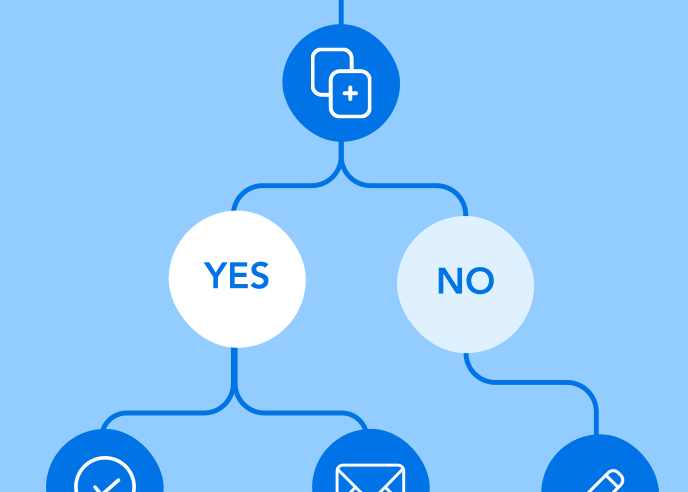
Conditional logic in a loan application gives a single applicant, a married couple, and a business borrower different questions.
- Our conditional logic shows the Additional Borrower section when the applicant adds one.
- Conditional logic shows employment questions that match the income type.
- Conditional logic shows property questions that match a purchase or a refinance.
- The applicant sees a shorter path, and staff receive relevant answers and nothing else.
Validation in Loan Application Intake
Validation in loan application intake catches errors while the applicant can fix them.
- Our validation rules cover required fields, length limits, email format, numeric input, number ranges, date ranges, custom formats, input masks, and regular expressions.
- Lending teams should match the validation rules to the lending system, because a value that passes the form can fail downstream.
Document Collection With the Loan Application
Document collection inside the loan application keeps each file with the answer it supports.
- Our document upload ties each file to the question that asks for it, so a pay stub arrives attached to the income section and does not sit in an inbox.
- Repeatable sections capture each employer, each account, or each additional borrower as a separate entry.
- Each repeatable entry becomes its own record.
Routing the Loan File With a Decision Trail
A loan application that passes intake needs review, and routing decides who reviews the file and how each decision is recorded.
- Our approval workflows send the file to the right underwriter or analyst by loan type or amount.
- Approval workflows keep each decision with a comment.
- Approval workflows return incomplete files to the applicant with a reason.
- Our e-signature collection completes disclosures and consents in the same flow, and the signed documents attach to the record.
Where FormAssembly Fits
At FormAssembly, we handle loan application intake from the first form through approval in one platform.
- Our conditional logic adapts each form to the applicant, and our validation checks values before submission.
- Our document upload keeps files with answers, and our approvals route each file with a full audit trail.
- Our forms connect directly to Salesforce, so the applicant, the co-borrowers, and the documents land in the system of record that loan officers use, with no re-keying.
- Our SOC 2 Type II, PCI DSS support, and field-level audit trail address the questions in a vendor security review.
Operations managers at financial services firms get complete files at the start of review, which shrinks the manual queue where it begins.
Frequently Asked Questions
What is loan application intake?
Loan application intake is the stage where a lender collects the facts about people, income, assets, and property that a loan file needs. A structured intake form mirrors the sections a lender expects, validates answers, collects documents, and routes the file for review, so reviewers receive complete files.
What causes manual review in loan applications?
Four patterns create most of the manual review queue. Applicants skip questions that apply to them, applicants answer questions that do not apply, documents arrive by email, and data lands in the lending system through re-keying. Each pattern traces to the form, and each pattern has a form-level fix.
What sections does the Uniform Residential Loan Application include?
Fannie Mae publishes the Uniform Residential Loan Application as Form 1003. The URLA includes Borrower Information, Lender Loan Information, an Additional Borrower form, an Unmarried Addendum, and a Continuation Sheet.
Can a loan application form send data to Salesforce without re-keying?
A loan application form can send data to Salesforce without re-keying when the form platform connects directly to Salesforce. At FormAssembly, our forms connect directly to Salesforce, so the applicant, the co-borrowers, and the documents land in the system of record that loan officers use.
What security questions should lenders ask a loan application form vendor?
Lenders should ask about SOC 2 Type II, PCI DSS support, and a field-level audit trail during a vendor security review. At FormAssembly, our SOC 2 Type II, PCI DSS support, and field-level audit trail address the questions in that review.
Want to see FormAssembly in action?
Book a personalized demo or request a free trial of the platform today.