Health systems operating across multiple hospitals, clinics, and specialty sites face a data collection challenge that does not exist at a single-site practice. The same information needs to be collected consistently everywhere, but the workflows, staff capabilities, and patient populations vary significantly from site to site. What works for an academic medical center with a dedicated IT team may not work for a rural clinic with limited technical support.
The organizations that manage this well have made deliberate architectural decisions about centralization and standardization. Here is what that looks like in practice.
The Core Problem: Inconsistency Compounds Across Sites
In a single-site practice, a poorly designed intake form affects one location. In a health system with twenty sites, it affects all twenty, and the inconsistency between site-level variations makes system-wide reporting and quality measurement unreliable.
The most common manifestation is field-level variation. Site A captures race and ethnicity data using one set of response options; Site B uses different categories. Site A collects a detailed medication list on intake; Site C collects only current medications. Site A routes form submissions to the EHR directly; Site D still relies on staff to transfer paper intake into the system manually. None of these variations are visible from the center until someone tries to aggregate data across sites and discovers the records cannot be compared.
The compliance dimension compounds this. A health system subject to HIPAA needs to ensure that every site collecting PHI is doing so with platforms that meet Security Rule requirements and have signed Business Associate Agreements in place. A site that adopted a consumer form tool without IT review creates compliance exposure for the entire system, not just for that location.
The Centralized Platform Model
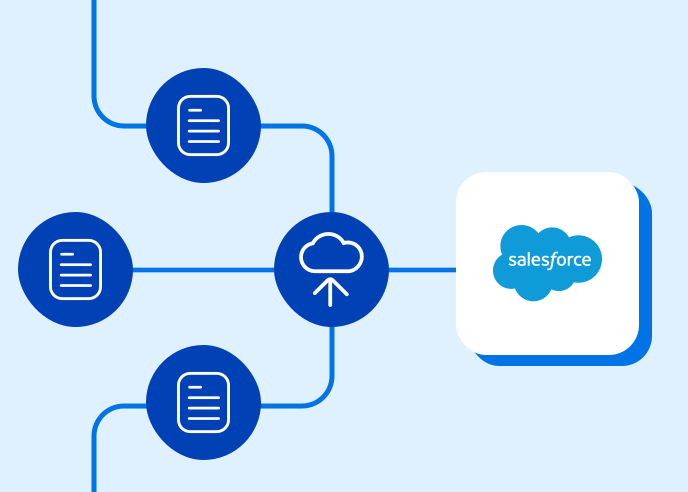
The architectural solution most health systems are moving toward is a centralized form platform governed by IT, with standardized templates that sites use as the starting point for their specific workflows.
In this model, the health system IT team maintains a library of approved form templates covering common intake scenarios: new patient registration, pre-visit health history, consent documentation, post-visit follow-up, and specialty-specific intake forms for high-volume service lines. Sites deploy from these templates rather than building from scratch, which ensures that the fields, response options, and Salesforce mapping that the central team has validated are preserved.
Sites retain the ability to customize within defined boundaries. A cardiology clinic can add cardiology-specific fields to the standard intake template without restructuring the core demographic and consent sections that feed enterprise reporting. A behavioral health site can add mental health screening instruments to the standard new patient form. The central team sets the governance rules about which sections are locked and which are customizable.
FormAssembly’s team and organization management features support this model, allowing health system IT to manage a central form library with role-based access that controls which staff at which sites can create, modify, or publish forms.
Standardizing Salesforce Health Cloud Mapping Across Sites
The value of standardized form templates depends on standardized Salesforce mapping. If each site’s version of the new patient intake form writes to different Health Cloud fields, the centralization of the form layer has not solved the data consistency problem.
Health systems using Salesforce Health Cloud should establish a canonical field mapping for each form template, documented at the system level and applied consistently across all site deployments. This mapping should specify the target object, the API field name, the expected data format, and any transformation logic needed to get submitted data into the right format for the Health Cloud field.
When a site needs a site-specific field that does not exist in the system’s standard Health Cloud configuration, that field should be added to the enterprise Health Cloud schema by the central team rather than handled through a workaround that creates a parallel data structure. Site-specific customization that is not reflected in the enterprise data model is a data quality problem waiting to surface in a system-wide report.

Managing HIPAA Compliance Across Sites
A centralized platform simplifies HIPAA compliance management in multi-site health systems significantly. When all sites use the same FormAssembly environment covered by a single Business Associate Agreement, the compliance posture of the data collection layer is uniform and auditable from the center rather than requiring individual review of each site’s tool choices.
Role-based access controls in a centralized platform allow the health system IT team to configure site-specific permissions that limit staff to accessing only the form submissions relevant to their location. A registration coordinator at Site A should be able to view intake submissions from Site A patients but not from Site B patients. A system-level administrator can see submissions across all sites for audit and quality purposes.
Audit logging in a centralized platform provides system-level visibility into form access events across all sites. When a privacy officer needs to respond to a patient inquiry about who accessed their intake information, the audit log covers the full system rather than requiring site-by-site investigation.
Training and Change Management Across a Distributed Staff
The technical architecture of a centralized platform is only as effective as the staff using it. Health systems with many sites and high clinical staff turnover face a persistent challenge in keeping form workflows operating as designed.
The most effective approach is building training materials directly into the platform workflow rather than relying on separate documentation that staff may not find or read. FormAssembly’s form instructions and help text features allow the central team to embed guidance at the field level, so staff completing or reviewing forms encounter the relevant guidance in context rather than needing to consult a separate manual.
Change management for form updates should include a communication process that reaches form administrators at each site before changes go live. A form that changes without notice to the staff who use it creates errors and confusion that undermine the data quality goals the change was intended to support.
Explore FormAssembly for Healthcare
See how FormAssembly keeps your data collection processes HIPAA-compliant.