Most public sector data collection problems start upstream, at the moment information first enters a system. And in a public sector environment, where every software system has to clear FedRAMP, HIPAA, or DOD-level scrutiny, the cost of getting that software choice wrong compounds quickly.
In a recent webinar with partners from Coastal and Carahsoft, we unpacked what it takes to architect secure, real-time data pipelines for Salesforce, and why “modernizing the mission” almost always starts with data hygiene. Below are five takeaways from the presentation worth carrying into your next data collection conversation.
1. Public sector data collection is a compliance discipline, not just a UX discipline.
Public sector teams operate under tighter scrutiny than nearly any other sector. Grant applications, warfighter/contractor onboarding, federal student applications, and constituent intake all look similar to private-sector forms, but the compliance perimeter around them is entirely different.
That’s why certifications like FedRAMP and DOD IL4 exist, and why software procurement and adoption in the public sector moves more slowly than in commercial industries. Tools that work fine for a private sector SaaS startup often won’t clear the bar for a federal agency, which leaves many public sector teams reaching for the same legacy systems they’ve used for decades. A recent LevelBlue study found that nearly half of US agencies lack full visibility into their own systems and the partners connected to them — a textbook example of legacy issues creating new legacy issues.
The fix isn’t more legacy – or using non-compliant tools. It’s employing modern, certified alternatives.
2. The biggest AI risk in the public sector isn’t the AI — it’s the data feeding it.
AI delivers value in the public sector only when the humans-in-the-loop framing is treated as non-negotiable: your team reviews, your team approves, your team decides. But before that conversation even starts, there’s a more fundamental problem to solve — the quality of the data going in.
In a recent FormAssembly survey of AI decision makers:
- 43% of team time was reported as being spent preparing or cleaning data before it could be used in AI or analytics workflows.
- 80% of respondents said they spent between one and five hours preparing data for every single hour they actually spent inside an AI tool analyzing it.
Garbage in, garbage out is the unglamorous truth at the center of every AI implementation. Dirty inputs produce unreliable analysis, and unreliable analysis erodes the trust agencies need to place in their data for AI to be worth the investment. The most successful public sector AI initiatives invest in clean intake before they invest in the model.
3. Salesforce Data Cloud is only as useful as the intake feeding it.
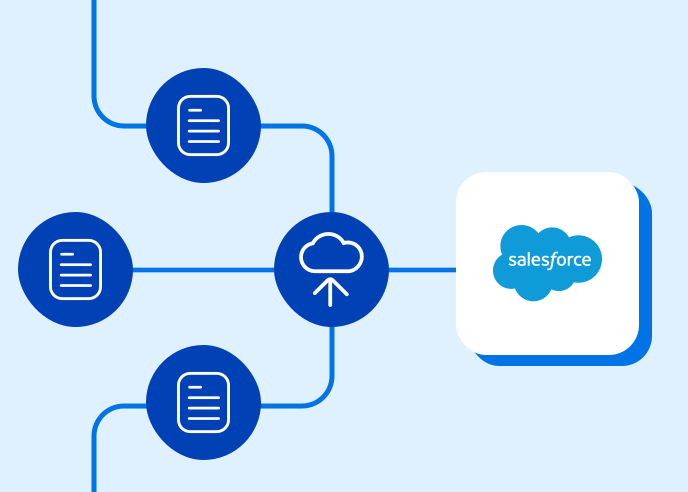
Salesforce Data Cloud is one of the strongest tools available for unifying public sector data into a single, governed source of truth. It harmonizes information across caseworker systems, constituent self-service portals, and agency back-end records into one 360-degree profile.
But Data Cloud doesn’t fix dirty upstream data. It surfaces it.
Public sector implementations — from departments of transportation monitoring road traffic and accident rates to state agencies coordinating constituent-facing services — are increasingly leaning on Data Cloud as the connective layer between systems. The agencies getting the most return are the ones that invest in clean, validated intake at the moment data enters the ecosystem, not as a cleanup project months later.
4. Authentication should serve both security and the respondent experience.
Strong authentication and a frictionless respondent experience are often framed as a tradeoff. They don’t have to be.
The most modern public sector data collection workflows use the agency’s existing identity providers — CAS, LDAP, SAML, or Salesforce SSO — to authenticate respondents before they ever see a form. Once authenticated, known information can be safely prefilled from Salesforce, leaving the respondent to confirm or update rather than retype.
That approach delivers two outcomes at once:
- It keeps sensitive data secure and partitioned at the user level, with each respondent only seeing what they’re authorized to see.
- It gives the respondent — a constituent, a warfighter, an employee — an experience that feels modern, respectful, and trustworthy.
A form that knows nothing about you and asks you to re-enter information your agency already has erodes trust. A form that’s clearly authenticated and thoughtfully prefilled earns it.
5. FedRAMP-authorized doesn’t mean stuck in 1999.
One of the most persistent myths in public sector technology is that “secure” and “modern” are at odds. They aren’t anymore.
Public sector teams now have access to FedRAMP-authorized and DOD IL4-environment-ready tools that include drag-and-drop workflow building, no-code Salesforce integrations, and human-centered AI agents that propose, pause, and wait for approval before taking the next step. That last design choice matters: in environments where AI skepticism is justifiably high — and where features like FormAssembly’s Fai can be turned off at the instance level for agencies that prefer it that way — the human-controlled rhythm of a modern AI tool is what makes adoption feasible at all.
The modernization gap between commercial and federal tooling is closing. The public sector doesn’t have to settle for legacy data collection just to stay compliant.
Watch the full webinar
The full session includes a live walkthrough of a FormAssembly workflow build, the Salesforce Data Cloud integration patterns the speakers recommended for public sector teams, and the audience Q&A on data cleanup, no-code integration setup, and how to think about Salesforce Experience Cloud alongside dedicated data collection tools.