If you find yourself manually re-entering data from Salesforce into forms or asking users to retype information you already have, you’re creating unnecessary friction, delays, and risk in your data collection processes.
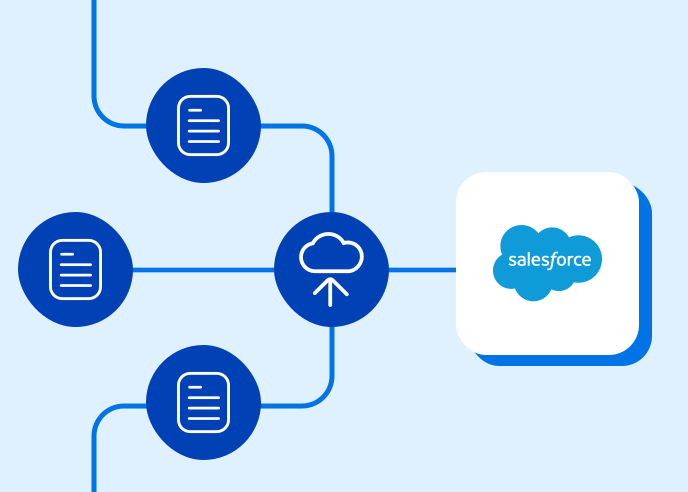
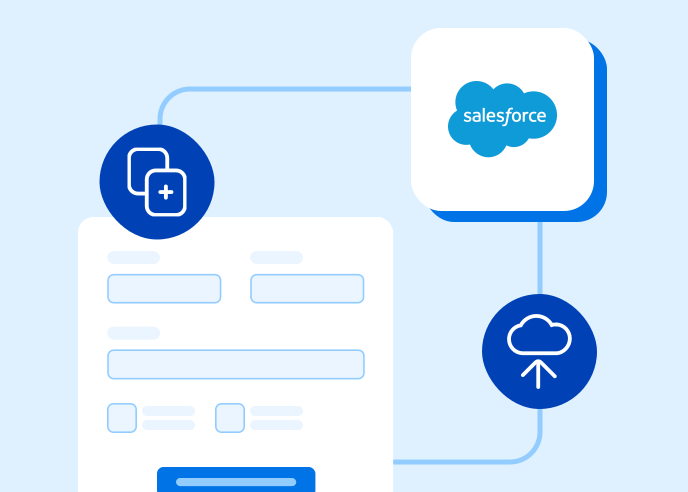
Utilizing prefill in the Salesforce Workflow Connector can help you alleviate these problems by enabling you to automatically pull Salesforce data into your FormAssembly workflows so you can reduce duplicate work, eliminate errors, and build smarter, more connected experiences.
In this recap of our recent webinar, “The Power of Prefill: How to Make the Most of the Salesforce Workflow Connector Capabilities,” we’ll walk through practical examples you can apply immediately.
Don’t feel like reading the recap? You can watch the full presentation on demand here.
Why Prefill Matters
If you’re the person on your team who is responsible for:
- Managing registrations
- Logging customer feedback
- Updating Salesforce records
- Coordinating events
- Processing service requests
You’ve likely experienced a number of these things:
- Jumping between 6–8 Salesforce objects
- Copying and pasting account data
- Double-checking IDs
- Fixing data entry mistakes
- Rebuilding context from scratch
Prefill eliminates these annoyances, saving you time and giving you peace of mind that the data you are working with is accurate and usable.
Let’s take a look at some examples that were shared during the webinar presentation to gain an understanding of how prefill works and why it is so impactful.
NOTE: To take advantage of the power of prefill seen below, you’ll need to be on a Team plan or higher in FormAssembly Atlas or FormAssembly Classic, as well as have the Salesforce Connector enabled.
- Want to learn more about these plans and see an in-depth demo of these features in action? Talk to our Sales team today.
- Want to update your existing FormAssembly account to take advantage of these features? Contact an Account Manager.
1. Prefill a Contact Record at the Start of a Workflow
One of the most common use cases where prefill is helpful is event registration.
The Scenario:
You send an event registration email to contacts from Salesforce. Each recipient clicks a personalized link to a form and sees the following fields already filled in:
- First Name
- Last Name
- Company
All they need to do next is confirm or update the information that has been prefilled and then submit the form.
How It Works:
Using the Salesforce Workflow Connector, you:
- Create a URL parameter (e.g., Contact ID)
- Use a Lookup Record action
- Map Salesforce fields to:
- Form fields
- Workflow variables
- Generate a prefilled link using the built-in link builder
The result: No manual entry, system hopping, or ID mismatches.
Secure vs. Unsecure URL Parameters
You can choose from the following options for your URL parameters:
- Secure parameter → Adds an encrypted key requirement
- Unsecure parameter → No encryption key required
The right choice depends on your organization’s security requirements. Either way, you maintain control over how data is retrieved.
2. Launch a Prefilled Workflow from a Salesforce Button
Prefill doesn’t have to start with an email. There are a variety of ways to implement, including:
- Adding a Salesforce button to an Account or Contact
- Opening a prefilled workflow
- Pulling in account details automatically
Example: Logging Customer Feedback
Instead of…
- Opening Salesforce
- Searching for account data
- Copying fields into a form
…prefill allows you to click a button and have everything where you need it. You only need to focus on entering new information.
This dramatically reduces the context switching that can slow you down when you are being plagued by manual work and duplicative processes.
3. Prefill Repeatable Records (Multiple Related Records)
Prefill becomes even more powerful when working with related records.
Example: Pulling All Contacts Associated with an Account
Instead of pre-filling one contact, you can:
- Look up an Account
- Retrieve all related Contacts
- Prefill them into a repeatable section
Key configuration steps to follow:
- Use a Lookup Record action
- Select “If multiple records found → Select all records”
- Map fields to a repeatable section
- Ensure repeated content mapping is set correctly
Now you can review or update multiple related records in one streamlined workflow!
4. Prefill Mid-Workflow (Unlocking Advanced Use Cases)
When you implement prefill mid-workflow, the Salesforce Workflow Connector is especially powerful.
Taking this approach allows you to:
- Capture respondent input
- Use it to look up related Salesforce data
- Prefill the next step dynamically
Example: Event Availability by Venue
- User selects a venue
- Workflow runs a Salesforce lookup
- All events tied to that venue appear (prefilled)
- User selects which events to register for
Using prefill partway through creates adaptive workflows that respond to user input in real time.
Use Preconditions to Control When Prefill Runs
Repeatable actions support preconditions, taking things a step further by allowing you to define: “Only run this action if X is true.”
For example:
- Only pull events if venue selection is not blank
- Only retrieve records if a specific condition is met
This gives you precise control over workflow behavior.
5. Use Workflow Variables to Power Downstream Actions
Prefill isn’t just about displaying data. It’s also useful for storing Salesforce values in workflow variables, referencing them later in the workflow, and using them to create tasks, update opportunities, and trigger additional actions.
Example: Service Request Workflow
- Customer submits request
- Salesforce Connector pulls account data
- Workflow checks if customer is “Priority”
- Conditional step determines follow-up process
- Later step creates a task using prefilled Account ID and Contact ID variables
A process like this avoids redundant lookups and duplicate actions.
6. Form-to-Form Prefill (Internal Efficiency Boost)
You can also prefill data from one form step into another.
Example:
- Customer submits service request
- Internal team member opens follow-up step
- All customer-submitted data is already visible
This means no digging through Salesforce to piece together context. Everything stays inside the workflow.
7. Advanced Tip: Appending Instead of Overwriting Salesforce Data
By default, Salesforce updates overwrite fields. However, you can:
- Prefill the existing Salesforce value into a workflow variable
- Use a formula to concatenate:
- Existing value
- New submission data
- Send the combined value back to Salesforce
This allows you to simulate “append” behavior for text fields while maintaining control over field limits.
Salesforce Workflow Connector vs. Legacy Form Prefill Connector
Here’s how FormAssembly’s older form-level Salesforce prefill connector compares to the new Salesforce Workflow Connector:
| Legacy Form Connector | Salesforce Workflow Connector |
| Form-level only | Full workflow-level control |
| Limited action logic | User-friendly action configuration |
| Prefill and submit separated | Pull and send data in one Connector |
| No mid-workflow lookups | Supports dynamic mid-process lookups |
| Limited branching | Supports conditionals, preconditions, and variables |
If you’re hesitant to migrate from using the Legacy Form Connector to the new Salesforce Workflow Connector, you’re not alone. Many teams start by replicating an existing process in the workflow builder to unlock more flexibility and get a feel for how all of this works in action.
How Prefill Reduces Friction Across Your Processes
Across all examples, the pattern with prefill is consistent:
You reduce:
- Duplicate data entry
- Manual record lookups
- Context switching
- Error risk
- Time spent navigating Salesforce
You gain:
- Smarter automation
- More adaptive workflows
- Cleaner Salesforce data
- Faster task completion
- Better user experiences
For teams managing complex processes, that translates directly into time saved and fewer mistakes.
Where to Start
If you want to explore prefill using the Salesforce Workflow Connector:
- Review your most repetitive data-entry process
- Identify where Salesforce data is already available
- Decide whether prefill should occur:
- At workflow start
- Mid-workflow
- Across repeatable sections
- Use workflow variables to avoid redundant lookups
Even implementing one use case can eliminate hours of manual work per week for you and your team.
Final Takeaway: Prefill is More Than Convenience
Prefill in the Salesforce Workflow Connector isn’t just about saving keystrokes. It’s about designing intentional data journeys, making workflows adaptive, using Salesforce as a live data source, and reducing operational friction at scale.
When you combine prefill, repeatables, workflow variables, and preconditions, you unlock workflows that are smarter, cleaner, and significantly more efficient. For teams juggling multiple systems, that’s where the real impact begins.
- Want to learn more about these plans and see an in-depth demo of these features in action? Talk to our Sales team today.
- Want to update your existing FormAssembly account to take advantage of these features? Contact an Account Manager.