If your nonprofit donor data collection CRM is filled with duplicate records, inconsistent fields, or data your team doesn’t trust, the issue likely starts before the data ever reaches Salesforce.
For many organizations, donor data is technically “there,” but not usable. That gap between collection and usability creates risk for fundraising, reporting, and donor relationships. The way you capture data directly determines your nonprofit CRM data quality, and ultimately, how effectively your team can act on it.
This guide outlines how to build a donor data collection process that produces clean, connected, and actionable data in Salesforce.
What Donor Data You Actually Need
Collecting more data does not necessarily improve outcomes. In fact, it often does the opposite.
Long forms, loosely defined fields, and one-off campaign data points tend to produce inconsistent, incomplete, and unreliable data. Over time, that erodes trust in your CRM and limits your ability to use it effectively.
A better approach is to align data collection with real use cases:
- What information does your team rely on for donor outreach and stewardship?
- What fields drive segmentation and campaign targeting?
- What data connects donors to programs, outcomes, or impact?
Most nonprofits find that a focused dataset delivers the most value. Core data typically includes:
- Contact information
- Giving history
- Communication preferences
- Acquisition source
- Relevant relationships (events, programs, affiliations)
Every additional field should have a clear, defined purpose tied to fundraising, reporting, or engagement. This approach improves completion rates and strengthens nonprofit CRM data quality at the source.
Structuring Salesforce NPSP Donor Data Correctly
For organizations using Salesforce Nonprofit Success Pack (NPSP), structure matters as much as content. Poor alignment between forms and your data model leads to manual cleanup, duplicate records, and broken reporting.
A strong donor form Salesforce integration ensures that data maps cleanly to standard objects:
Contacts and Households
NPSP uses a Household Account model. Donors should be captured as Contacts, with household relationships managed within Salesforce – not through manual or freeform inputs.
Opportunities (Donations)
Each donation should create or update an Opportunity record with the correct amount, stage, and date. Form submissions should map directly to Opportunities, not just update Contact fields.
Affiliations and Relationships
Employer or organizational connections should be stored using NPSP Affiliation objects. This keeps relationship data structured, reportable, and scalable.
Campaign Attribution
Tracking which efforts drive donations requires mapping submissions to Campaign Members. Capturing campaign data as structured fields – not free text – ensures accurate attribution and reporting.
When your forms align to the NPSP data model, you reduce downstream work and improve overall Salesforce NPSP donor data integrity.
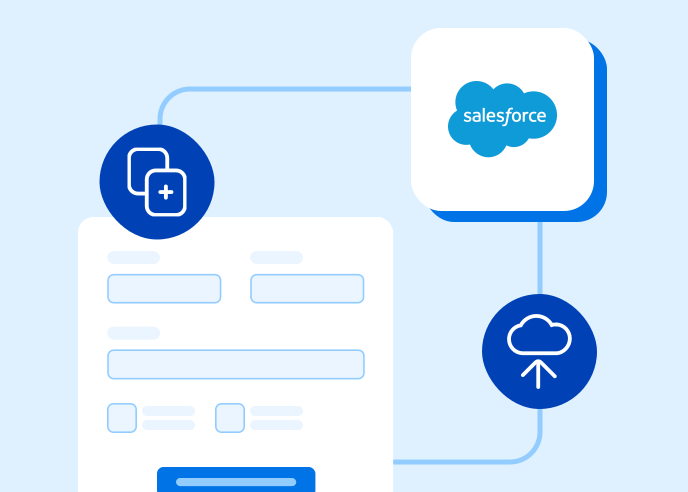
How Donor Forms Should Connect to Salesforce
Disconnected systems are a primary source of poor data quality.
Without a reliable donor form / Salesforce integration, nonprofits often face the problems of duplicate records, incomplete updates, or manual data re-entry. These issues introduce risk, slow teams down, and reduce confidence in reporting.
A well-designed integration should:
- Check for existing records before creating new ones to prevent duplicates
- Map form inputs to the correct Salesforce fields using API names
- Support multi-object record creation (e.g., Contact + Opportunity + Campaign Member) in a single flow
- Pre-fill known data for returning donors to reduce friction and improve accuracy
FormAssembly’s Salesforce integration is designed to support these requirements. By capturing data through secure, governed forms and writing it directly into Salesforce in real time, organizations can standardize how data enters their systems while reducing manual effort.
Pre-filled forms also improve both user experience and data consistency. When donors confirm existing information instead of re-entering it, variation decreases and trust in the data increases.

Managing Donor Communication Preferences
Communication preferences are a common failure point in nonprofit CRM data quality.
When preferences are stored across spreadsheets, disconnected tools, or inconsistent fields, organizations risk sending the wrong messages or violating donor expectations and compliance requirements.
To address this:
- Establish Salesforce as the single source of truth for communication preferences
- Ensure every form writes directly to the correct preference fields
- Align those fields with your email or marketing automation platform
- Update preferences in real time when donors submit changes
This approach ensures that communication data remains accurate, compliant, and immediately actionable across systems.
Practical Steps to Improve Donor Data Quality
Improving your nonprofit donor data collection CRM does not require a full rebuild. Most organizations can make meaningful progress by focusing on a few high-impact changes:
Audit your current forms
Identify unused, inconsistent, or low-value fields and remove them.
Map every field intentionally
Document where each form field lives in Salesforce, including object, field name, and formatting rules.
Test end-to-end data flow
Validate that submissions create or update the correct records, with no duplicates or missing relationships.
Standardize data collection processes
Use governed, secure forms instead of ad hoc or manual data entry wherever possible.
Review data quality regularly
Track duplicate rates, field completion, and accuracy over time to catch issues early.
Building a Strong Foundation for Fundraising and Growth
Clean, structured, and reliable data is the foundation for effective fundraising, reporting, and donor engagement.
By improving how you capture and connect Salesforce NPSP donor data, you reduce risk, strengthen compliance, and enable your team to operate with confidence. More importantly, you create a system where data supports your mission rather than slowing it down.
A thoughtful approach to nonprofit donor data collection CRM ensures that every form submission contributes to a more complete, accurate, and actionable view of your donors.
Improve donor retention at the point of giving.
Book a personalized demo