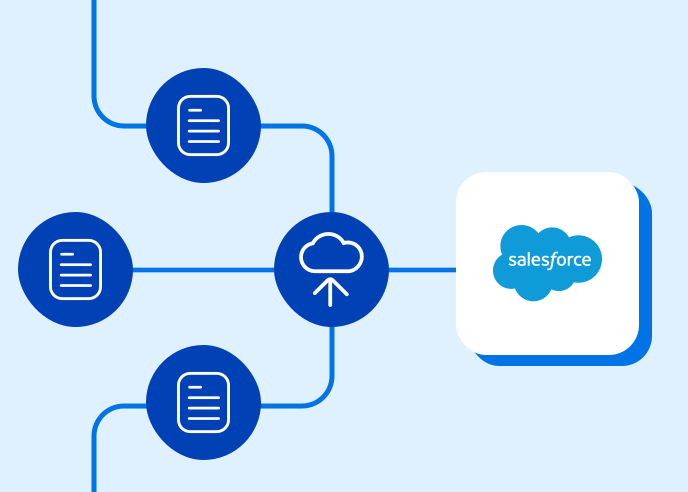
A Salesforce Admissions Connect FormAssembly integration allows higher education institutions to capture applicant data securely and deliver it directly into Salesforce without manual entry, disconnected systems, or inconsistent records.
Admissions Connect extends Salesforce Education Cloud with a purpose-built admissions data model. However, the quality, completeness, and usability of that data depend on how it is collected. Without a structured, integrated data collection layer, institutions risk delays, errors, and limited visibility across the admissions lifecycle.
This guide explains how to build a FormAssembly integration with Admissions Connect, with a focus on data integrity, process efficiency, and scalable admissions workflow automation in Salesforce.
How the FormAssembly Admissions Connect Package Works
The FormAssembly Admissions Connect package installs directly into your Salesforce org and connects forms to Admissions Connect objects using pre-configured mappings.
This enables higher education Salesforce application forms to write directly to the data model that admissions teams rely on.
Core objects supported by the integration include:
- Applicant (Contact): The individual applying
- Application: The application record tied to the applicant
- Program: The academic program or major
- Decision: Records that track admissions outcomes and stages
When a form is submitted, FormAssembly processes the data and updates Salesforce in real time. For a new applicant, this typically includes:
- Creating or updating the Contact record
- Creating an Application record
- Associating the Application with the correct Program
This approach ensures that every submission contributes to a complete, structured applicant record—improving visibility for admissions, recruitment, and enrollment teams.
Setting Up Application Routing
Application routing is a critical component of any Salesforce Admissions Connect FormAssembly integration.
Each submission must be accurately assigned to the correct program, term, and review workflow. Without structured routing, applications can be misdirected, delayed, or require manual intervention.
A reliable routing strategy includes:
Capturing structured program and term data
Forms should collect program selection and entry term using controlled fields (not free text).
Mapping to Salesforce record IDs
These values must align with Program and Term records in Salesforce to ensure accurate routing.
Using dynamic, multi-step forms
For institutions with large program catalogs, conditional logic can narrow options based on earlier responses. This improves the applicant experience while maintaining precise data capture.
This structured approach supports scalable admissions workflow automation in Salesforce and reduces administrative overhead.
Explore FormAssembly for Higher Ed
Schedule a personalized demo
Data Mapping for Admissions Connect Objects
Accurate field mapping is essential for ensuring that data lands where Admissions Connect expects it.
Contact (Applicant) Fields
Standard fields such as name, email, phone, and address should map directly to the Contact object. Admissions-specific data (e.g., GPA, prior education) may live on either the Contact or Application object depending on your configuration.
Application Fields
The Application object stores key details such as:
- Application type (first-year, transfer, graduate)
- Submission date
- Application status
Status fields are especially important, as they often trigger downstream workflows and communications.
Checklist Items
Admissions Connect uses Checklist Item records to track required materials. Forms can be configured to create or update these records when applicants submit documents or complete required steps.
Relationship Data
For programs requiring recommendations, additional workflows can capture recommender information and create relationship records that link back to the applicant.
A well-structured mapping strategy ensures clean, complete Salesforce Education Cloud admissions forms data and reduces the need for manual corrections.
Integrating with Admissions Decision Workflows
Admissions Connect supports multi-stage decision workflows, and FormAssembly can integrate at multiple points in that process.
Collecting additional information during review
Forms can be triggered at specific stages to gather supplemental materials, financial aid data, or interview availability. Submissions write directly to the relevant Application or Decision records.
Capturing applicant responses to decisions
Post-decision forms – such as enrollment confirmations, scholarship acceptances, or deposit submissions – can be pre-filled with applicant data and tied back to Salesforce.
This creates a connected experience where every interaction is tracked, structured, and actionable within Salesforce.
Testing the Integration Before Launch
Admissions data directly impacts enrollment outcomes, so testing should go beyond basic validation.
Key steps include:
Test multiple applicant scenarios
Include first-year, transfer, international, and multi-program applicants to ensure the data model handles all variations.
Validate duplicate management
Returning applicants should update existing records rather than creating duplicates. Matching logic (e.g., email-based) should be tested thoroughly.
Confirm workflow automation
Verify that status updates, checklist creation, and routing logic trigger correctly within Admissions Connect.
Run a controlled rollout
Launch with a limited set of applications before full deployment to validate performance and identify any gaps.
Thorough testing ensures that your Salesforce Admissions Connect FormAssembly integration supports both operational efficiency and data accuracy from day one.
Building a Scalable Admissions Data Strategy
A well-designed integration does more than connect forms to Salesforce. It creates a reliable, governed data pipeline that supports the full admissions lifecycle.
By standardizing how data is collected through higher education Salesforce application forms, institutions can:
- Reduce manual processing and administrative burden
- Improve data accuracy and completeness
- Accelerate admissions decisions and communications
- Provide a more seamless applicant experience
With the right approach to admissions workflow automation in Salesforce, every submission becomes part of a unified, trusted system—helping institutions move faster while maintaining control over their data.
Need help using FormAssembly?
Our Knowledge Base has step-by-step guides to walk you through the platform.