Beneficial ownership collection became a mandatory component of customer due diligence for covered financial institutions in 2018 under FinCEN’s CDD rule. Since then, the Corporate Transparency Act has expanded beneficial ownership reporting requirements further, and regulators have made clear through examination findings that beneficial ownership collection gaps are taken seriously.
For compliance and operations teams managing customer onboarding workflows, here are five things that matter most when it comes to collecting beneficial ownership information correctly.
1. The Rule Requires Two Certifications, Not One
FinCEN’s CDD rule requires covered financial institutions to collect beneficial ownership information for legal entity customers through a certification form. That form has two components that are sometimes treated as one.
The ownership prong requires identifying and verifying each individual who directly or indirectly owns 25% or more of the legal entity. The control prong requires identifying and verifying one individual who has significant responsibility to control, manage, or direct the entity, regardless of whether that person owns any equity. Both prongs must be satisfied for every legal entity customer.
A certification form that collects only ownership information and omits the control prong is not compliant. Examiners look for both components, and the absence of the control person certification is a common finding in AML program reviews.
2. The Collection Must Happen at Account Opening, Not After
The CDD rule requires beneficial ownership information to be collected at account opening, before the account becomes operational. Collecting it afterward, even by a short interval, creates an exception that needs to be documented and justified. Patterns of post-opening collection are a red flag in examination findings.
Building beneficial ownership collection into the account opening form workflow, as a required section that the form cannot proceed past without completion, is the most reliable way to ensure collection happens at the right time. FormAssembly’s field logic and conditional routing can enforce this at the form level, preventing the submission of a legal entity account opening form without a completed beneficial ownership certification.

3. Verification Requirements Apply to the Information Collected
Collection and verification are distinct requirements. Collecting the beneficial owner’s name and date of birth satisfies the collection requirement. Verifying that the person who was certified actually exists and is who they claim to be requires additional steps.
For beneficial owners, verification is typically accomplished through documentary verification (a copy of a government-issued photo ID) or non-documentary verification (checking the information against reliable third-party sources). The institution’s customer identification program (CIP) procedures define what verification methods are acceptable for different customer types.
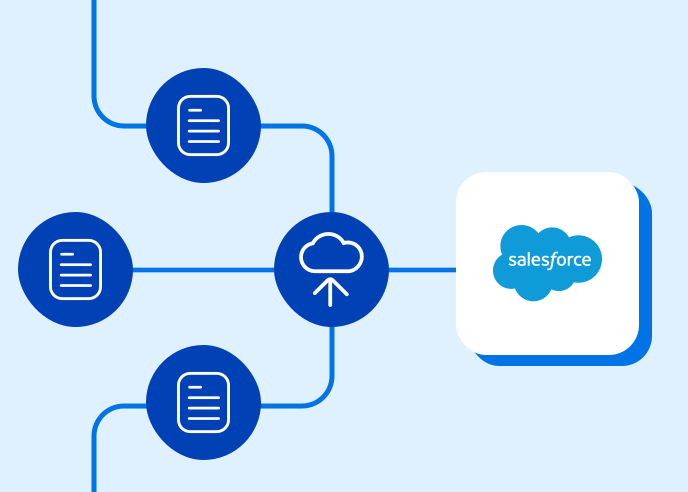
Document upload fields in the beneficial ownership certification form allow beneficial owners to submit identity documents at the same time as the certification, connecting collection and verification in a single workflow. Documents route to the Salesforce Financial Services Cloud account record for compliance team review without requiring a separate document request and follow-up cycle.
4. Recertification Is Required When Ownership Changes
The CDD rule’s ongoing monitoring requirement includes updating beneficial ownership information when the institution becomes aware of changes. For legal entity customers, that means having a process for recollecting beneficial ownership certification when ownership structure changes are reported or detected.
In practice, institutions typically handle recertification through a periodic review process for all legal entity customers, triggered by time (annual review of higher-risk customers) or by events (a transaction pattern suggesting a change in business activity, a news report of a corporate restructuring, or a customer-initiated account update). A recertification form pre-filled with existing beneficial ownership data from Salesforce allows the customer to confirm continued accuracy or update the record efficiently, with a new timestamped certification replacing the prior one on file.
5. The Corporate Transparency Act Adds a New Layer
The Corporate Transparency Act (CTA), which took effect in January 2024, requires most domestic and foreign companies doing business in the United States to report beneficial ownership information directly to FinCEN. This is a reporting obligation that falls on the reporting company, not the financial institution, but the practical effect for financial services teams is that customers subject to the CTA have already been through a beneficial ownership identification process.
Financial institutions cannot rely on CTA filings to satisfy their own CDD rule requirements. The two frameworks are parallel, not substituted for each other. But the CTA creates an opportunity to streamline verification workflows, since customers who have filed CTA reports with FinCEN have already documented their beneficial ownership structure in a formal, government-filed format that can be used to corroborate the information provided on the institution’s beneficial ownership certification form.
Staying current on FinCEN’s guidance about how CTA compliance and CDD rule compliance interact is important for financial services compliance teams as implementation continues to evolve.
Learn how to digitize your client forms with FormAssembly.
Schedule your personalized demo today.