FISMA shapes how federal agencies buy software, run security assessments, and manage the vendors that handle government data. But for all its influence, it is often explained in ways that are either too abstract to act on or too buried in regulatory language to be useful.
Here are seven things every federal IT team should have a working understanding of, whether you are evaluating a new data collection platform, preparing for an audit, or just trying to get the right answer when someone asks.
1. FISMA Applies to Vendors, Not Just Agencies
The Federal Information Security Modernization Act is not limited to federal employees or agency-owned systems. Any contractor or third-party service provider that operates information systems on behalf of a federal agency is subject to FISMA requirements. That includes software vendors, cloud platforms, and any tool that handles federal data as part of its service.
In practice, this means your vendor list is also a compliance list. Before a third-party tool processes government data, it needs to meet FISMA standards, which for cloud software typically means FedRAMP authorization.
2. NIST 800-53 Is the Control Framework FISMA Relies On
FISMA establishes the requirement for a security program but delegates the technical specifics to the National Institute of Standards and Technology. The relevant document is NIST Special Publication 800-53, which defines the security and privacy controls federal information systems must implement.
SP 800-53 Rev. 5 is the current version. It is organized into control families covering access control, audit and accountability, configuration management, incident response, and more. Knowing which controls apply to a given system, and at what baseline, is the operational starting point for FISMA compliance work.
3. Systems Are Categorized as Low, Moderate, or High
Not every federal system faces the same compliance requirements. FISMA uses a tiered impact categorization based on the potential consequences of a security failure. A system handling public-facing informational content has different stakes than one processing sensitive citizen data or classified information.
The categorization determines which NIST 800-53 controls are required and how rigorously they must be implemented. For most data collection systems handling program data or citizen information, Moderate is the typical baseline. That categorization also sets the bar for any vendor tools operating within that system’s boundary.
4. FedRAMP Is the FISMA-Compliant Path for Cloud Tools
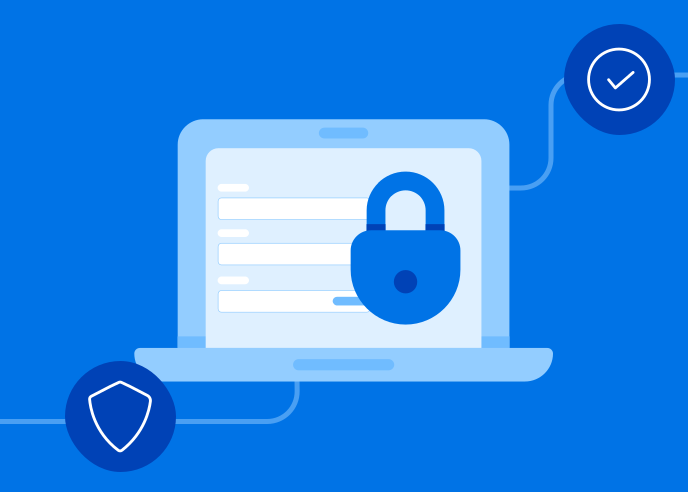
If you are evaluating a cloud-based data collection platform, form builder, or any SaaS tool that will handle federal data, FedRAMP authorization is the FISMA-compliant path. The FedRAMP program applies NIST 800-53 controls to cloud services and requires an independent third-party assessment before a product can be listed as authorized.
The FedRAMP Marketplace shows authorized products with their impact levels. An ‘In Process’ listing means assessment is underway, not that authorization exists. Only ‘Authorized’ products have completed the process.
5. The Risk Management Framework Is What Produces an ATO
FISMA compliance for a given system is not a status you achieve once. It is maintained through an ongoing process defined by NIST SP 800-37, the Risk Management Framework. The RMF walks systems through categorization, control selection, implementation, assessment, authorization, and continuous monitoring.
The output of that process is an Authority to Operate. ATOs are granted by an Authorizing Official and are typically issued for three years with continuous monitoring requirements. When a vendor achieves FedRAMP authorization, it has completed the RMF for its cloud service, which agencies can leverage in their own ATO processes.
6. Audit Logging Is a Frequently Failed Control in Data Collection Environments
The NIST 800-53 AU control family requires federal systems to generate, protect, and retain audit logs sufficient to reconstruct relevant events. For data collection tools, that means logging form submission events, configuration changes, user access, and data retrieval.
Many general-purpose form tools do not provide the kind of event-level logging that satisfies these controls. That gap becomes visible during FedRAMP assessments and agency security reviews. When evaluating a data collection platform, ask specifically about log content, retention periods, tamper protection, and SIEM export capability.
7. FISMA Compliance Is Ongoing, Not a One-Time Certification
One of the most common misunderstandings about FISMA compliance is treating it as a point-in-time achievement. Completing an ATO or confirming that a vendor is FedRAMP authorized is the beginning of the compliance relationship, not the end.
FISMA requires annual reviews, continuous monitoring, and ongoing documentation of control effectiveness. For vendors, FedRAMP authorization includes annual assessments and continuous monitoring reporting. For agencies, the Authorizing Official is responsible for monitoring whether authorized systems remain compliant as environments change.
FormAssembly is FedRAMP Authorized, which means it has completed the full RMF process and maintains the ongoing monitoring program FedRAMP requires. Federal IT teams can use FormAssembly’s authorization package in their own ATO documentation, reducing the security review burden on internal staff.