Implementing Salesforce well is difficult, especially when teams are balancing data quality, security, integrations, and change management. Many organizations can configure the platform, but achieving a scalable system with strong adoption depends on having the right expertise at the right time. Selecting the right Salesforce implementation partner is critical to accelerating time-to-value and setting a foundation for long-term success.
ForteNext is a FormAssembly partner that works with organizations to plan, implement, and optimize Salesforce across a range of use cases and delivery models. Their teams regularly help customers evaluate implementation approaches, align Salesforce capabilities to business goals, and scale responsibly as requirements evolve.
This guide, written by Simon Wright, explores the essential factors to consider when selecting a Salesforce-certified outsourcing company, from product and industry expertise to service models, location considerations, and practice size.
Salesforce revenues are projected to exceed $41bn this year, with approximately 90% of customers relying on certified consultants to implement and optimize their systems. Yet finding the right experts has never been more challenging: demand for technical architects surged 27% in 2025 while supply grew only 4%. For buyers looking to outsource key skills, this creates a sellers’ market where the stakes are high, the right consultant can deliver rapid time-to-value, while the wrong choice can restrict growth entirely.
This guide explores the essential factors to consider when selecting a Salesforce-certified outsourcing company, from product and industry expertise to service models, location considerations, and practice size.
What are Salesforce “partners” anyway?
Think of them as Salesforce’s vetted experts – over 3,000 companies worldwide that have proven they can implement, optimize, and support Salesforce projects successfully.
Why they exist: Most organizations lack the internal expertise to handle Salesforce implementations themselves. These partners fill that gap, bringing specialized knowledge from initial setup through ongoing optimization and strategic innovation.
How Salesforce vets them: Through rigorous verification including due diligence questionnaires, anti-bribery compliance checks, and a performance-based Trailblazer Score measuring customer success, innovation, growth, and impact. Partners who excel earn tiers like Summit (the highest), Crest, Ridge, or Base.
When to bring one in: Once your business objectives are clear but before you’ve made specific technology decisions. The right team will help you refine success metrics, recommend the appropriate Salesforce products, and develop realistic timelines.

The three non-negotiables:
Before diving into details, focus on these three make-or-break factors. Everything else is negotiable depending on your situation.
1. Industry experience you can verify
Generic Salesforce knowledge isn’t enough. You need consultants who understand your sector’s unique challenges, compliance requirements, and business processes. A consultant who knows Sales Cloud inside-out but doesn’t understand healthcare compliance will cost you time and money.
Verification checkpoint: Ask for client references in your specific industry. If they can’t provide at least two, keep looking.
2. Deep expertise in your specific Salesforce Clouds
Your consultant should know your required products cold, not just “we’ve done some Sales Cloud projects.” They should speak fluently about the specific challenges and best practices for the clouds you’re implementing.
Verification checkpoint: Ask them to describe their most complex project involving your required clouds. Generic answers are red flags.
3. Cultural fit and communication style
You’ll be working closely with these people for months. If their communication style drives you crazy during the sales process, it won’t improve during implementation.
Verification checkpoint: Pay attention to how they communicate during discovery calls. Are they listening or just pitching? Do they ask thoughtful questions about your business or jump straight to Salesforce features?
Salesforce’s core products:
Salesforce’s core products are its foundational CRM clouds: Sales Cloud for sales automation; Service Cloud for customer support; Marketing Cloud for personalized campaigns; and Commerce Cloud, for e-commerce, all built on the unified Salesforce Platform with integrated AI (Einstein) for a 360-degree view of the customer (Customer 360). Other key areas include Data Cloud, Tableau for analytics, MuleSoft for integration, and Slack for collaboration, extending the core platform’s reach.
Agentforce represents autonomous AI agents that handle complex tasks like service case resolution and sales development. Look for consultants who can articulate clear use cases, understand the Einstein Trust Layer for security, and have experience building custom actions for agents.
Data Cloud has emerged as the foundational layer for modern implementations, serving as the unified customer data platform. Top-tier firms demonstrate experience with data ingestion from diverse sources, unified profile creation, and data governance including GDPR and CCPA compliance.
Einstein powers AI capabilities throughout Salesforce. Evaluate potential vendors on their experience implementing Einstein features across clouds; lead scoring, Einstein Bots, Discovery for predictive analytics, and Copilot for conversational AI.
Sales Cloud remains the foundation for most organizations. Look beyond basic configuration skills to consultants who understand complex opportunity management, territory design, and CPQ for sophisticated pricing models.
Service Cloud powers omnichannel customer support. Performant implementation teams understand omnichannel routing, case management workflows, knowledge base optimization, and Field Service Lightning for mobile workforce management.
Marketing Cloud enables sophisticated multi-channel campaigns and requires specialized expertise. Look for teams who understand email marketing best practices, journey builder, audience segmentation, and integration with other clouds.
Commerce Cloud (B2B and D2C) powers digital shopping experiences. Implementation specialists should demonstrate understanding of modern commerce challenges: headless architecture, personalization, mobile-first design, and conversion optimization.
Experience Cloud enables branded portals for customers, partners, and employees. Best-in-class specialists combine design expertise with technical capabilities, understanding authentication, content management, and data access security.
Revenue Cloud combines CPQ, billing, and revenue management. Expect expertise in complex pricing scenarios, subscription management, usage-based billing, and revenue recognition requirements.
Connecting with your tech stack
MuleSoft provides enterprise integration capabilities. In complex environments, MuleSoft expertise is essential for connecting Salesforce with other systems, managing data synchronization, and implementing secure integrations.
Tableau provides advanced analytics beyond native Salesforce reporting. Strong analytics teams help unlock insights through sophisticated dashboards and predictive analytics.
Multi-Cloud Integration expertise, connecting Sales Cloud with Service Cloud, integrating Marketing Cloud with Commerce, is increasingly essential as Salesforce footprints expand.
Tailored to your sector
Salesforce also offers Industry Products for Higher Ed, financial services, healthcare, manufacturing, and other sectors. Consultants with industry cloud expertise understand sector-specific challenges and can accelerate implementation using pre-built components.
Education Solutions address unique needs of educational institutions around student lifecycle management and compliance with regulations like FERPA.
Nonprofit Solutions help charitable organizations with donor management, fundraising, program management, and outcome measurement, often with resource-constrained budgets in mind.
Complementary products that can help minimise TTV
Heroku enables custom applications that extend Salesforce. Implementation teams with Heroku expertise bridge the gap between configuration and custom development for sophisticated use cases.
Slack integration transforms team collaboration by bringing Salesforce data into the flow of work. Look for firms who understand workflow automation and bot development.
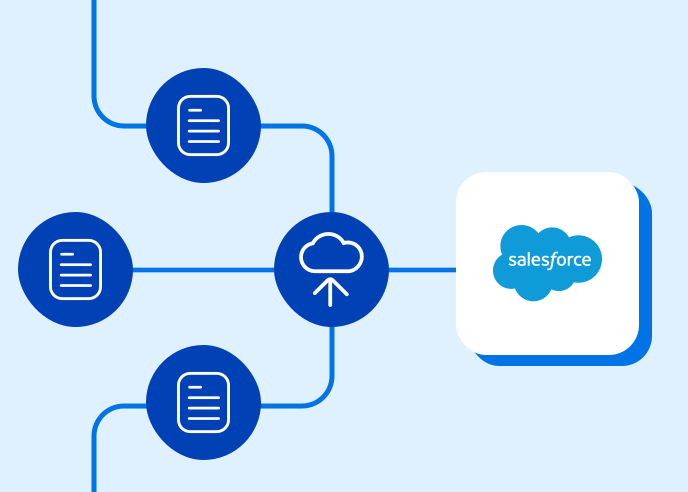
Implementation timelines often slow down when teams struggle to capture, standardize, and route data into Salesforce reliably. FormAssembly helps accelerate time-to-value by making it easier to launch branded, compliant data-collection experiences such as onboarding, applications, service requests, and internal workflows that connect directly to Salesforce. With flexible form logic, workflow automation, and governed integrations, teams can reduce manual entry and rework, improve data quality from the start, and move more quickly from go-live to measurable outcomes.
Make sure they’re experienced with your industry (and can prove it)
Effective implementation requires a deep understanding of your industry’s unique challenges, processes, and regulations. Industry expertise allows consultants to recommend best practices and help avoid costly errors.
Financial Services specialists understand stringent regulatory requirements, complex product offerings, and wealth management processes. They navigate FINRA, SEC, and banking compliance requirements.
Healthcare & Life Sciences experts manage HIPAA compliance, patient engagement, care coordination, and the unique needs of providers, payers, and pharmaceutical companies.
Manufacturing consultants understand complex supply chains, configure-price-quote for complex products, dealer management, and integration with ERP systems.
Retail specialists manage omnichannel experiences, inventory systems, point-of-sale integration, and clienteling processes that connect physical and digital retail.
Public Sector & Government teams understand government-specific compliance, citizen engagement strategies, accessibility standards, and procurement processes.
Higher Ed experts know the student lifecycle, admissions processes, financial aid systems, and educational data privacy regulations.
Energy & Utilities consultants manage asset management, regulatory compliance, outage management, and meter-to-cash processes.
Nonprofit specialists understand donor management, fundraising best practices, the Nonprofit Success Pack, and the resource constraints of mission-driven organizations.
Professional Services teams manage client relationships, project delivery, time-based billing, and resource allocation for consulting, legal, and accounting firms.
Other critical industries include Automotive (dealer management, connected vehicles), Communications (subscriber management, service provisioning), Consumer Goods (trade promotion, retail execution), and Travel & Hospitality (reservations, loyalty programs, dynamic pricing).
Do you want to outsource the whole operation, or just some key skills?
Different organizational situations require different consulting relationships. Understanding service models helps you find the right fit.

Implementation partner
Full-service implementation companies such as ForteNext can manage your entire project from discovery through go-live. They can provide end-to-end project management, business analysis, technical architecture, configuration, testing, training, and change management. This model works well for organizations undertaking significant initiatives without internal Salesforce expertise.
Managed services
Managed services providers handle ongoing Salesforce operations – help desk support, system administration, configuration changes, security management, and release management. This model works well for organizations wanting to outsource routine maintenance while internal teams focus on strategic initiatives.
Staff augmentation
Staff augmentation provides skilled professionals who work as extensions of your internal team. This model offers flexibility to scale resources based on project needs, access specialized skills temporarily, and maintain control over project direction. It works well when you have strong internal management but need additional capacity or specialized expertise.
Product development outsourcer (PDO)
PDO relationships involve building custom Salesforce applications or AppExchange products. This suits organizations creating proprietary solutions that significantly extend platform capabilities, requiring deep development expertise and understanding of AppExchange requirements.
Complementary services
Consider firms offering integration services (connecting Salesforce with other systems), data services (migration, cleansing, quality management), change management (driving user adoption), analytics (advanced insights and predictive modeling), and ongoing optimization (health checks and continuous improvement).
Balancing geography with capabilities
The location and delivery model of your consulting team significantly impacts cost, communication, and collaboration effectiveness.
Blending DIY with resource redeployment
Insourcing means building an internal Salesforce team. This offers maximum control, immediate availability, and deep organizational knowledge. It makes sense when Salesforce is central to operations, you have sufficient scale for full-time headcount, and you can attract top talent.
However, insourcing challenges include expensive Salesforce expertise, difficulty maintaining current knowledge across the expanding platform, and limited exposure to external best practices.
Outsourcing provides access to specialized expertise, scalability for project demands, and exposure to best practices from multiple implementations. It works well when Salesforce isn’t central to operations, for one-time implementations, or when significant expertise gaps exist internally.
Many organizations find a hybrid approach optimal – a core internal team (1-3 administrators and business analysts) who understand your organization deeply, while leveraging external consultants for specialized needs, project-based work, and capacity during peaks. This provides organizational knowledge from internal staff combined with specialized expertise from outside experts.
Balancing time zones with access to skills
Onshore consultants in your country offer easier communication, cultural alignment, and simpler contracting, though typically at premium pricing. Best for strategic initiatives requiring close collaboration.
Nearshore agencies in nearby countries provide moderate cost savings with overlapping working hours and similar cultural norms. Effective for organizations seeking cost advantages without offshore communication challenges.
Offshore BPOs in distant countries offer significant cost advantages and access to large talent pools. Cost-effective for well-defined technical work with strong internal project management.
Distributed models combine resources across geographies; onshore architects for strategy, nearshore developers for custom work, offshore resources for testing. This balances cost, expertise, and collaboration needs.
Minimizing downtime from lack of mission-critical skills
Staff augmentation addresses temporary or specialized skills gaps without building permanent headcount. It works well when you need additional capacity for specific projects, require specialized expertise not needed full-time, are building internal capabilities but need temporary support, or have unexpected departures creating immediate gaps.
Make staff augmentation successful by treating augmented staff as team members, clearly defining roles and responsibilities, establishing decision-making processes, and planning for knowledge transfer.
How to evaluate consulting firms (without getting burned)
Customer reviews and third-party validation provide insights marketing materials never will.
Salesforce AppExchange: Your first stop
AppExchange is Salesforce’s official marketplace where consulting partners list their services and collect customer reviews.
What to look for:
Overall rating and review volume
Firms with 4.5+ stars and 20+ reviews demonstrate consistent customer satisfaction. Be skeptical of perfect 5.0 ratings with only a handful of reviews, could be cherry-picked or incentivized.
Review recency
Recent feedback matters more than old. A firm with excellent reviews from five years ago but nothing recent may have changed significantly. Look for consistent feedback over the past 6-12 months.
Specific feedback patterns
Don’t just read star ratings; dig into actual comments about communication, technical expertise, project management, and post-implementation support. Notice patterns across multiple reviews.
If five different clients mention “poor communication during implementation,” believe them. If three clients praise “going above and beyond when we hit issues,” that’s meaningful.
Partner tier matters
Salesforce categorizes consulting companies into four tiers based on Trailblazer Scores:
- Summit: Highest level – proven track record across customer success, innovation, growth, and impact
- Crest: Consistent performers with significant expertise
- Ridge: Established firms with solid capabilities
- Base: Entry level – newer or smaller practices
Summit doesn’t automatically mean “best for you” (a boutique Ridge firm might be perfect for your needs), but it does indicate proven capability at scale.
Partner response to reviews
How do they respond to both positive and negative feedback? Thoughtful responses to criticism show maturity and commitment to improvement. Defensive or dismissive responses are red flags.
Independent review platforms
Platforms such as G2 and Clutch provide extra context with B2B buyers, while Glassdoor will help buyers see under the hood – each 1-star improvement in Glassdoor company ratings translates into a predicted 7.8 to 18.9% higher stock market valuations through improved customer satisfaction.
Advantages:
- More detailed project descriptions
- Comparative analysis (see how firms stack up against each other)
- Verified reviews from confirmed users
- Filter by company size, industry, or project type
How to use them:
- Look for reviews from companies similar to yours in size and industry
- Pay attention to “cons” sections – what are clients consistently frustrated about?
- Check if reviewers would work with the firm again (strongest signal of satisfaction)
Red flags in reviews:
- Many reviews posted simultaneously (suggests incentivized feedback)
- Generic praise without specifics (“Great team, very professional”)
- Defensive responses to any criticism
- No reviews at all (for firms claiming years of experience)
- Consistent complaints about communication, timeline slippage, or surprise costs
How to actually use reviews
Look for patterns across multiple sources: One negative review is less concerning. Consistent themes across 5+ reviews warrant attention.
Consider context: A review from a Fortune 500 company may not be relevant if you’re a 50-person business, and vice versa.
Verify claims: If a firm claims expertise in your industry, reviews should mention that industry. If they claim strong project management, look for specific evidence.
Balance quantity and quality: 100 mediocre reviews doesn’t beat 20 glowing reviews from similar companies.
Watch for suspiciously perfect: If every review is 5 stars with generic comments and similar phrasing, be skeptical.
Juggernaut or boutique agency?
Practice size significantly impacts capabilities, resources, and appropriate fit for your project.
1-5 professionals: boutique consultancies
Strengths: Personalized attention, direct access to senior consultants, lower rates, flexibility, and deep relationships.
Best fit: Small to mid-sized businesses, straightforward implementations, and organizations valuing personal relationships.
6-20 professionals: growing specialists
Strengths: Personal attention with increasing capabilities, role specialization, and strong client service focus.
Best fit: Mid-sized businesses, moderate complexity projects, and organizations wanting growth-oriented relationships.
21-100 professionals: Established regional players
Strengths: Proven methodologies, diverse skillsets, resource availability, balanced rates, and experience across industries.
Best fit: Mid-market to large enterprises, complex multi-cloud implementations, and situations requiring proven methodologies.
101-200 professionals: Large regional or national firms
Strengths: Comprehensive capabilities, established practices, significant resource depth, and ability to handle concurrent projects.
Best fit: Large enterprises, complex multi-national implementations, and organizations needing extensive ongoing support.
201-1,000 professionals: Major national practices
Strengths: Extensive resources across geographies, deep specialized expertise, proven enterprise methodologies, and rapid scaling ability.
Best fit: Large enterprises with complex needs, multi-national implementations, and situations where strategic advisory matters.
>1,000 professionals: Global systems integrators
Strengths: Massive resource pools, global presence, experience with largest implementations, and transformational program capabilities.
Best fit: Global enterprises, transformational programs spanning multiple systems, and situations requiring global delivery.
The bottom line?
Don’t assume bigger is better. The best fit matches your organizational scale, cultural expectations, complexity needs, and budget while providing appropriate attention.
Salesforce outsourcing checklist:
Follow a structured evaluation process:
- Document your project objectives, needed Salesforce products, integration requirements, timeline, budget, and internal resources available.
- Identify 4-7 potential providers, review their profiles and case studies, verify certifications, and check for appropriate practice size.
- Assess their communication style and cultural fit, discuss requirements, ask about approach and methodology, and request client references.
- Ask for project approach, team composition, timeline, pricing, post-implementation support, and success metrics.
- Contact references and ask about what went well, how challenges were handled, communication quality, delivery performance, and whether they’d work with the firm again.
- Compare expertise, cultural fit, proposed approach, team quality, pricing, and references. Avoid choosing solely on price; the cheapest option can in some instances become the most expensive when requiring rework.
Setting a precedent
Ensure success by establishing clear communication protocols, planning for knowledge transfer to build internal capabilities, defining measurable success metrics beyond go-live, securing post-implementation support arrangements, building for scalability as your needs change, and maintaining the relationship as a long-term strategic partnership.
Take your time with this decision.
The right team will bring technical expertise, strategic guidance, industry knowledge, and a collaborative approach that amplifies your Salesforce investment.
Define your requirements clearly, research thoroughly, evaluate systematically, and select a consulting firm that aligns with your organizational culture, business objectives, and technical needs. You’re not just hiring someone to implement software – you’re selecting a strategic advisor who will help shape your organization’s digital future.